reverse mortgage
Canada's Reverse Mortgage Industry: Who's Who
Published July 4, 2026 · By YYZ Mortgage
Ask most Canadians to name a reverse mortgage company. You get one answer: “the CHIP people from TV.” That is real. But it is only part of the picture.
Canada’s reverse mortgage market is small and focused. It is growing fast as the country ages. Here are the players. Here is who really uses the product. And here is how smart users get it right.
The two big players
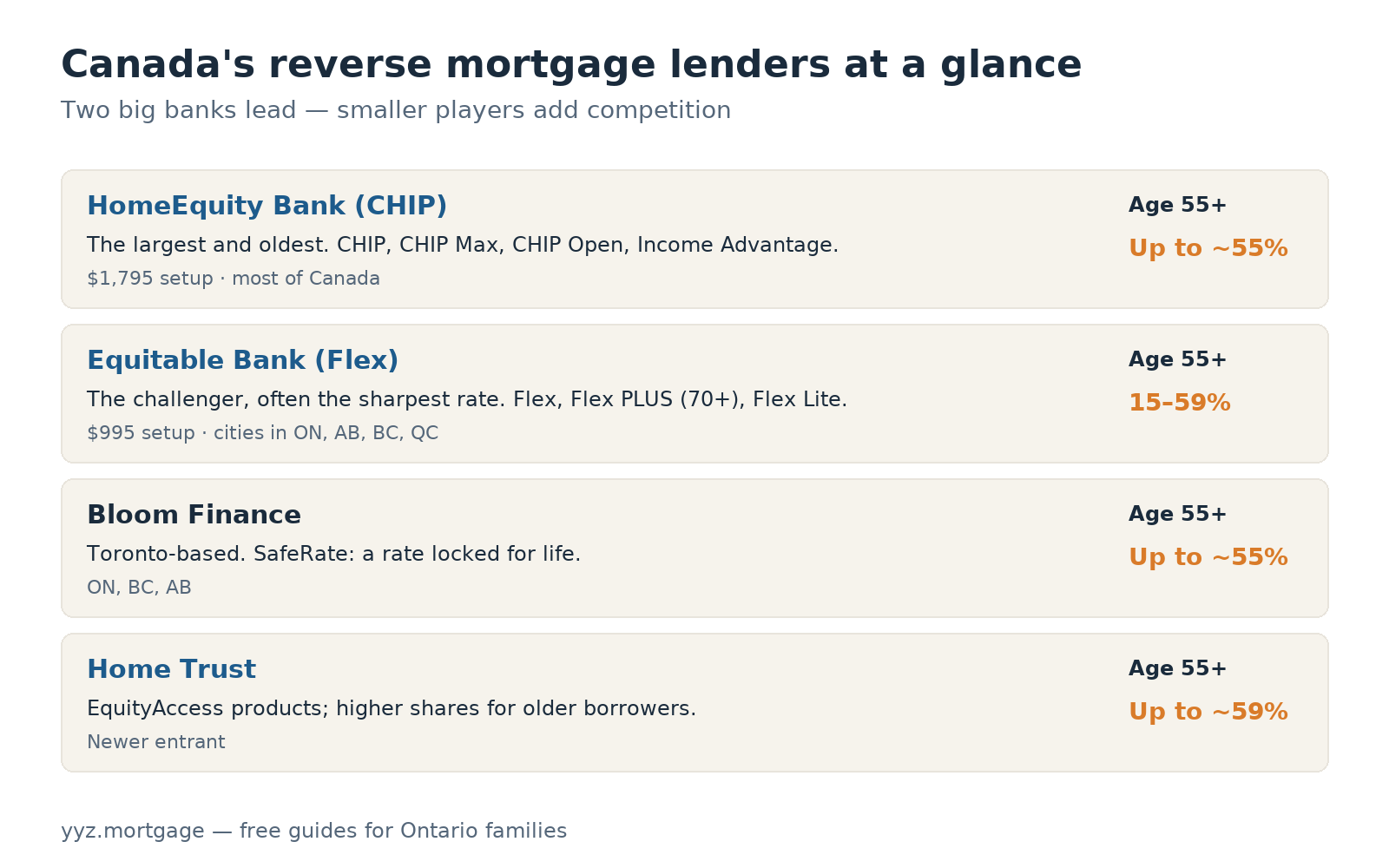
HomeEquity Bank — the CHIP family
HomeEquity Bank is the giant here. It is a bank, watched by federal rules. It has sold the CHIP Reverse Mortgage for decades. It is the name your parents know from TV.
Its products cover most needs:
- CHIP — the standard product. Lump sum or advances as you go.
- CHIP Max — higher loan amounts for those who qualify.
- CHIP Open — repay any time with no penalty, at a higher rate.
- Income Advantage — steady monthly or quarterly deposits, like a pension.
CHIP rates in 2026 mostly sit in the 6.5%–8.5% band. It varies by product and term. The standard setup fee is $1,795. It lends across most of Canada. That includes cities and many smaller places too.
Equitable Bank — the Flex family
Equitable Bank is the challenger. It is also a bank under federal watch. It came later and fights hard on price. Its Flex family:
- Flex — the standard product. Ages 55+, 15%–55% of home value.
- Flex PLUS — for ages 70+. Up to 59% of home value. That is the highest published share in Canada, at a higher rate.
- Flex Lite — smaller amounts (15%–40%), lump sum only, and often the sharpest rate in the market.
Equitable’s setup fee is $995. One catch. It lends in cities and most large towns in Ontario, Alberta, BC and Quebec only. Rural homes mostly fall outside its map.
The fight between these two banks helps you. Rates, fees and features differ week to week. Our CHIP vs Equitable comparison breaks it down line by line.
The smaller players
- Bloom Finance — a Toronto company serving Ontario, BC and Alberta. Known for SafeRate, a reverse mortgage with a rate locked for life.
- Home Trust — its EquityAccess products reach up to about 59% of home value for older borrowers.
Small players matter for one reason. More sellers means better prices. A broker who works the whole market can check them all in one pass.
Who is NOT in this market
Canada’s big six banks do not offer reverse mortgages. Not RBC. Not TD. Not Scotiabank, BMO, CIBC or National. Ask your bank, and you will hear about a HELOC or a refinance instead. Those are good tools if you pass the income test. And if you can carry a monthly payment. Many retirees cannot. That gap is why this industry exists. See reverse mortgage vs HELOC for the honest comparison.
Who actually uses reverse mortgages
The typical user is not who the myths say. It is not desperate people. It is owners with lots of house and thin monthly cash. The name for it: house rich, cash poor. In the GTA, an average home holds about a million dollars. So that describes a lot of streets.
The four most common users:
- Retirees still paying a mortgage. The payment fit a salary. It does not fit a pension. A reverse mortgage pays off the old loan. The monthly payment ends.
- People paying for care at home. Private care in Ontario often costs thousands a month. Home equity can pay for it — without moving.
- Parents helping kids buy. A down-payment gift, given while they are here to see it matter.
- Income toppers. A steady monthly draw. Tax-free. It does not touch OAS or GIS.
One more pattern. The adult children are often at the table now. Kids help compare. They watch for red flags. They ask the hard questions. Good lenders and brokers welcome that.
How the smart users do it
The product is a tool. How you use it decides the ending. The good endings share a pattern:
- Borrow the need, not the max. Interest compounds on every dollar taken. The cost math is honest but real.
- Match the money to the spending. One-time cost? Lump sum. Monthly gap? Monthly advances. Interest builds only on money already paid out. Over ten years the difference is huge.
- Both spouses on title and on the loan. This is the top protection in the whole industry. The survivor stays. No questions.
- Compare the whole menu first. Benefit checks. Tax deferral. A HELOC. Downsizing. All seven options. Sometimes the right answer is not a reverse mortgage. A broker who says so is a keeper.
- Keep the obligations current. Taxes. Insurance. Upkeep. Do that, and you cannot be forced out. And the no-negative-equity guarantee holds. You never owe more than the home’s fair market value.
Where the industry is heading
Canada is aging. More retirees carry mortgage debt than ever before. Home values hold most retirement wealth. All three lines point the same way. The market grows. More products appear. Prices sharpen. That is good news for borrowers — if they compare.
That is the whole game: compare. Two banks. Different rates. Different fees. Different maps. The free calculator shows your range in a minute. Then talk to a licensed Ontario broker who prices the whole market. We show CHIP, Equitable and the rest side by side. The comparison costs you nothing.
This article is general information, not financial, legal or tax advice. Mortgage products are subject to lender approval (OAC). Rates and product details change — confirm current terms before deciding. Speak with a licensed mortgage professional about your situation.
Frequently asked questions
Who offers reverse mortgages in Canada?
Two banks lead the market: HomeEquity Bank, which runs the CHIP family of products, and Equitable Bank, which offers the Flex family. Both are federally regulated Schedule I banks. Smaller players include Bloom Finance and Home Trust. Banks like RBC or TD do not offer reverse mortgages.
Which reverse mortgage company is the biggest in Canada?
HomeEquity Bank is the largest and oldest provider. Its CHIP Reverse Mortgage has been around for decades and is the name most Canadians know. Equitable Bank is the main challenger, and its rates are often sharper. That rivalry is good for borrowers — it is why comparing both matters.
Who uses reverse mortgages the most?
Homeowners 55 and older who are house rich and cash poor — big value in the home, tight monthly budget. Common users include retirees still carrying a mortgage payment, people funding care to stay home longer, and parents helping kids with a down payment.
What is the smartest way to use a reverse mortgage?
Borrow what you need, not the most you can get. Match the money to the spending: a lump sum for one-time costs like paying off a mortgage, monthly advances for income top-up. Put both spouses on the loan. And compare cheaper options first, like a HELOC or downsizing.
Are reverse mortgages regulated in Canada?
Yes, on two levels. The lenders are federally regulated banks, watched by OSFI. In Ontario, the brokers and agents who arrange the loans must be licensed by FSRA. Lenders also require independent legal advice — your own lawyer — before any deal funds.
Do Canadian banks like RBC or TD offer reverse mortgages?
No. The big six banks do not offer them. If you ask your bank, they may offer a HELOC or refinance instead. Those need income to qualify and monthly payments. A mortgage broker can show you both sides — bank products and reverse mortgages — priced against each other.
Figures shown are estimates only — not an offer of credit or a commitment to lend. The amount you may qualify for depends on the lender's assessment of your age(s), property type, location, appraised value and any existing liens. Reverse mortgage lenders require independent legal advice before funding. A reverse mortgage is not suitable for everyone; alternatives include refinancing, a home equity line of credit, or downsizing.