reverse mortgage
10 Questions to Ask Before Your Parents Sign
Published July 4, 2026 · By YYZ Mortgage
Your mom or dad called. They are thinking about a reverse mortgage. And now — like it or not — you are part of the decision.
Good. Families make better choices together. But you need to know what to ask. Here are the ten questions, in the order to ask them. Print this. Bring it to the meeting.
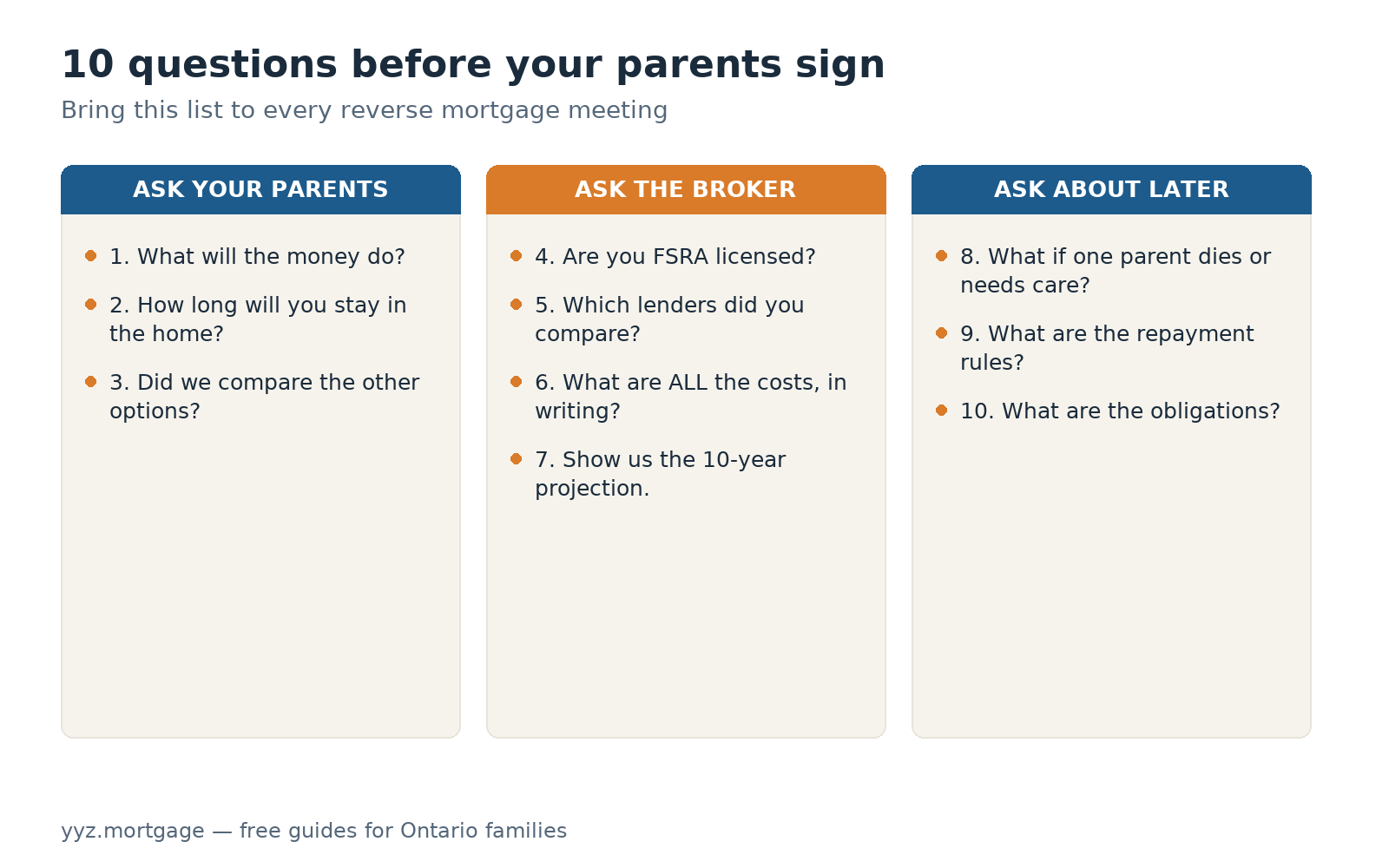
First: questions for your parents
1. “What will the money do?”
This is the big one. Ask it first. A clear answer is a good sign. “Pay off the mortgage and end the $1,600 payment.” “Pay for a caregiver three days a week.” “Fix the roof and the bathroom.” Those are real plans.
A vague answer is a yellow flag. “Just to have it” means interest will grow on money sitting in a bank account. That is a sure loss. If the need is monthly, ask about monthly advances instead of a lump sum. Interest only builds on money already paid out.
2. “How long do you plan to stay in the home?”
A reverse mortgage suits people who want to stay for years. Setup costs and early repayment penalties make short stays costly. If a move is likely within two or three years, other tools fit better. So does an honest look at downsizing.
3. “Have we looked at the other options?”
A reverse mortgage is not for everyone. There are seven ways to fix a cash squeeze. Some are free. Unclaimed benefits like GIS. Property tax deferral. A HELOC, if income allows. Downsizing. Renting out a suite. Walk through the full list together: house rich, cash poor: 7 options. A good broker will show this comparison without being asked.
Next: questions for the broker
4. “Are you licensed, and with whom?”
In Ontario, mortgage brokers and agents must be licensed by FSRA (the provincial regulator). Ask for the name and licence number. Then check it on FSRA’s public website. It takes two minutes. Every honest broker expects this question.
5. “Which lenders did you compare?”
Canada has more than one reverse mortgage lender. HomeEquity Bank (CHIP) and Equitable Bank are the big two. Their rates and fees differ. Ask to see the comparison — CHIP vs Equitable — with today’s rates and APRs in writing.
6. “What are ALL the costs?”
Get every number on paper. The interest rate and its APR. The setup fee (about $995 to $1,795). The appraisal (about $350 to $600). The cost of independent legal advice (advice from your parents’ own lawyer). The full cost guide shows what each one means.
7. “Show us the ten-year projection.”
Ask for a year-by-year table. Home value on one side. Loan balance on the other. Interest compounds — it grows on itself. Your parents should see what the balance looks like in year five and year ten. So should you. A broker who will not show this math is the wrong broker.
Then: questions about later
8. “What happens if one parent dies or needs care?”
If both parents are on the loan, the survivor stays. Nothing changes. If one moves to long-term care, the loan carries on while the other lives at home. Make sure both spouses are on title and on the loan. Read what happens with long-term care and what heirs should know.
9. “What are the repayment rules?”
The loan comes due when the home sells, when the last borrower moves out for good, or after the last borrower dies. The estate usually gets about 180 days. Early repayment can cost a penalty in the first years. Most products allow about 10% prepayment each year without one. Get the penalty table in writing.
10. “What are the obligations?”
Your parents must keep paying property taxes. They must keep home insurance. They must keep the home in fair shape. Do that, and two things hold true. They cannot be forced out. And the family never owes more than the home’s fair market value — that is the no-negative-equity guarantee, and those obligations are its condition.
Red flags that end the meeting
- Pressure to sign fast. A real offer survives a week of thought.
- Advice to invest the money. Borrowing at 7% to chase returns is a known trap. Regulators warn seniors about it.
- No written costs. No projection. No comparison of lenders.
- Anyone who discourages family from being in the room.
More on this: how to protect your parents from bad deals.
The safety net built into the process
Your parents cannot sign in the dark. Lenders require independent legal advice. That means your parents meet their own lawyer — not the lender’s — before funding. The lawyer confirms they understand the deal and are signing freely. It is a real safeguard. Treat it that way. Send your parents in with this list.
Want the numbers first? The free calculator shows what your parents could unlock. It takes a minute. No credit check. Then bring every question here to a licensed agent — we answer all of them, with family welcome at the table.
This article is general information, not financial, legal or tax advice. Mortgage products are subject to lender approval (OAC). Rates and product details change — confirm current terms before deciding. Speak with a licensed mortgage professional about your situation.
Frequently asked questions
What is the most important question to ask about a reverse mortgage?
Ask what problem the money will solve. A clear need — like ending a mortgage payment or paying for care — points to a good fit. A vague plan to have cash on hand usually means the family should slow down and compare other options first.
Should I be at my parents' reverse mortgage meetings?
Yes, if your parents want you there. Good brokers welcome family at the table. Your parents will also meet their own lawyer alone. That step is called independent legal advice, and lenders require it before funding.
How do I know if the amount my parents want is too much?
Interest grows on every dollar they take. So the right amount is what they need, not the most they can get. If the plan is to park a big lump sum in a savings account, ask about monthly advances instead. Interest only builds on money already paid out.
What fees should my parents expect?
An appraisal costs about $350 to $600. The lender's setup fee runs about $995 to $1,795 and comes off the money advanced. Their own lawyer charges for independent legal advice. Ask for every cost in writing before they sign.
Can my parents change their minds after signing?
Before funding, yes. After funding, they can repay, but early repayment can cost a penalty in the first years. Most products let them pay back about 10% each year without penalty. Ask for the full penalty table in writing.
What happens to the loan when my parents pass away?
The loan is repaid from the estate, usually when the home sells. With CHIP, the estate gets about 180 days. If taxes, insurance and upkeep were kept current, the family never owes more than the home's fair market value. Anything left belongs to the heirs.
Figures shown are estimates only — not an offer of credit or a commitment to lend. The amount you may qualify for depends on the lender's assessment of your age(s), property type, location, appraised value and any existing liens. Reverse mortgage lenders require independent legal advice before funding. A reverse mortgage is not suitable for everyone; alternatives include refinancing, a home equity line of credit, or downsizing.