reverse mortgage
The True Cost of a Reverse Mortgage in Canada (2026)
Published July 2, 2026 · By YYZ Mortgage
A reverse mortgage puts tax-free cash in your hands. You make no monthly payment. But none of it is free. A good adviser walks you through every cost. Any adviser who skips the costs is not doing their job.
Here is every cost, listed out, with real math. The numbers match lender terms published as of mid-2026. Rates and fees change. Check current terms before you decide.
The interest rate: the biggest cost by far
Most reverse mortgage rates in Canada sit in the 6.5%–8.5% range in 2026. The rate depends on the lender, the product, and the term. Regular 5-year mortgage rates are much lower. Well-qualified borrowers pay about 3.9%–4.4% this summer. (As of July 2026, OAC — on approved credit. Rates can change.)
Why the higher rate? The lender waits years to get paid back. Sometimes it waits decades. It collects nothing each month. It is also bound by the no-negative-equity guarantee (a promise that caps what you can owe). Keep property taxes, insurance, and upkeep current. Then you and your estate never owe more than the home’s fair market value (what your home would sell for). You pay a higher rate for that patience and that shield.
Here are two rates lenders have published. Both move over time. Treat them as examples, not quotes.
| Product | Sample 5-year fixed rate | APR | As of |
|---|---|---|---|
| Equitable Bank Flex Lite | 6.23% | 6.31% | Oct 30, 2025 (re-verify) |
| HomeEquity Bank CHIP | ”generally 6.5%–8.5%” across products/terms | varies | 2026 |
We build your estimate from each lender’s current rate sheet. We show the APR beside each rate. The APR folds the setup fee into the true cost. That is the number to compare.
One-time fees
| Cost | Typical amount | Who gets it | When |
|---|---|---|---|
| Appraisal | $350–$600 | Appraiser | When you apply |
| Setup / closing fee | $995 (Equitable) – $1,795 (standard CHIP) | Lender | Taken off your advance |
| Independent legal advice (ILA) | A few hundred dollars up to ~$1,800 | Your own lawyer | Before funding |
| CHIP Open setup | Greater of $2,995 or 1.25% of the loan | Lender | Taken off advance |
Three things worth knowing:
- The setup fee comes off your advance. So you rarely write a cheque for it. Borrow $200,000 from CHIP. Then $198,205 lands in your account.
- Independent legal advice (a review with your own lawyer, not the lender’s) is not padding. Lenders demand it before they fund the loan. It protects you. It is money well spent. Bring your questions to that meeting. Bring your kids too, if you can.
- Watch the trade-off between rate and fees. Some products, like CHIP Open, have no charge for early payout. But they cost more in fees and rate. No plans to repay early? Then don’t pay extra for a perk you won’t use.
The cost nobody lists: compound interest
Interest you don’t pay gets added to what you owe. The next period, you pay interest on that interest. This is compound interest. This part makes reverse mortgages stir debate. So let’s put real numbers on it.
Illustrative example. Say you take a $200,000 reverse mortgage at 7%. You make no payments. You hold it for 10 years:
| Year | Approximate balance |
|---|---|
| 0 | $200,000 |
| 3 | $245,900 |
| 5 | $282,100 |
| 7 | $323,600 |
| 10 | $397,900 |
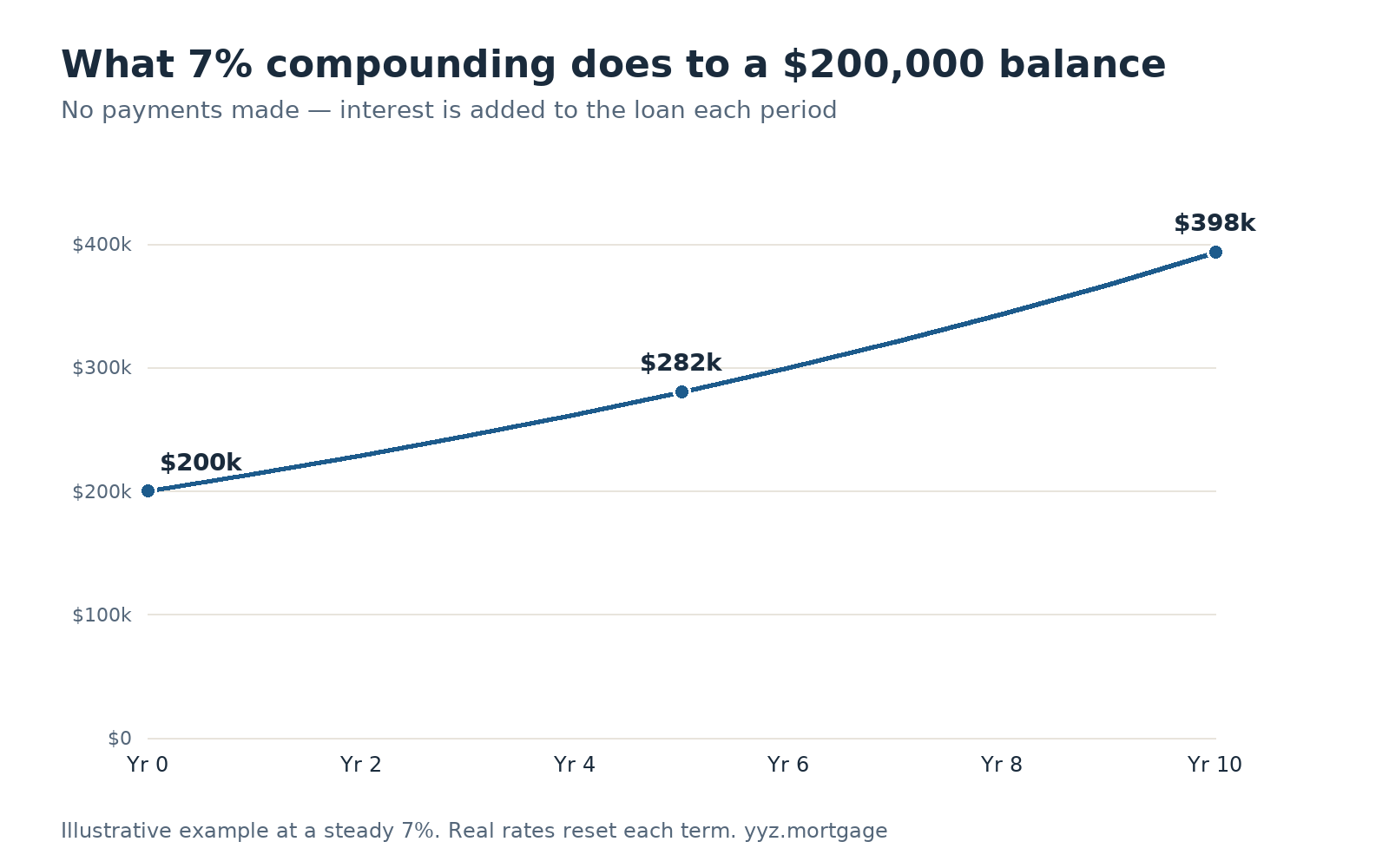
The balance roughly doubles in about 10 years. That is the honest math of 7% compound growth.
Now look at the other half of the picture. The home grows in value too. Take a $950,000 home that gains a modest 3% each year:
| Year | Home value (3%/yr) | Loan balance (7%) | Remaining equity |
|---|---|---|---|
| 0 | $950,000 | $200,000 | $750,000 |
| 5 | $1,101,300 | $282,100 | $819,200 |
| 10 | $1,276,700 | $397,900 | $878,800 |
In this case, your equity (your share of the home) grows in dollars. Why? The home is the bigger number. So its 3% beats the loan’s 7%. Now flip it around. Say home prices stall or fall. Or say you borrow the max at an older age. Then your equity can shrink a lot. Neither outcome is promised. What matters most? The size of the loan next to the home’s value. Borrow what you need, not all you are offered.
See your own numbers: our reverse mortgage calculator shows the range you could unlock. Your own breakdown comes with a growth table like the one above.
Charges for paying off early
A reverse mortgage is built to be repaid later. Most people repay when they sell, move out, or pass away. Pay it off much sooner, and charges can apply. Here is CHIP’s published schedule (contract versions vary):
- Year 1: ~5% of the amount repaid · Year 2: ~4% · Year 3: ~3%
- After year 3: three months’ interest
- Waived in full on death; cut by 50% if the last borrower moves to long-term care
- Most products also let you pay off ~10% of the balance each year with no charge
Do you expect to pay it off early — say, a planned sale in two years? Then a reverse mortgage is likely the wrong tool. We will say so. A refinance or HELOC most often fits a short time frame better.
Ongoing costs (not fees, but real)
You must keep property taxes, home insurance, and basic upkeep current. These are not lender profit. You pay them as a homeowner in any case. But falling behind can put the loan in default. It can also void the no-negative-equity guarantee. That guarantee only holds while taxes, insurance, and upkeep stay current. The home must also stay your principal residence (the home where you live most of the time). When you apply, lenders check that you can carry these costs.
How the total compares with other options
- HELOC: lower rate. But you must qualify on income and pay interest each month. The lender can also freeze it or call it. See reverse mortgage vs HELOC.
- Refinance: lower rate, but you must make monthly payments. You face full income and credit checks. It is the right answer for many people under 65.
- Downsizing: frees up the most money. But GTA selling and moving costs often run into the tens of thousands. And leaving your community has a cost money can’t measure. See reverse mortgage vs downsizing.
A reverse mortgage is not for everyone. It tends to win when staying home matters most to you. It also wins when monthly cash is tight. And it wins when you can’t qualify for other loans. Always compare it, in writing, against the other options. Work with a broker licensed by FSRA (the body that oversees Ontario’s mortgage brokers). We prepare that written comparison, free, for Ontario homeowners 55+.
Ready for real numbers instead of ranges? Get a free, no-strings estimate with our reverse mortgage calculator. It takes about a minute, with no credit check.
Is the interest tax deductible?
For most borrowers, no. Canada allows a deduction in one case only. The borrowed money must be used to earn income. That means income from investments or a business. Most reverse mortgage money (the funds you get) pays for daily living. Or it goes to home repairs, care costs, or other debts. None of those create a deduction. Also, the interest usually builds up. It is not paid each year. So there is often no paid interest to claim. That holds even in the rare cases. Does someone urge you to borrow against your home to invest? Do they say “the interest is deductible”? Treat that as the red flag it is. Get independent advice first.
This article is general information, not financial, legal or tax advice. Mortgage products are subject to lender approval (OAC). Rates and product details change — confirm current terms before deciding. Speak with a licensed mortgage professional about your situation.
Frequently asked questions
What fees do I pay upfront for a reverse mortgage?
Expect an appraisal fee of about $350 to $600 when you apply, plus a fee to your own lawyer for independent legal advice. The lender's setup or closing fee — about $995 at Equitable Bank or $1,795 for a standard CHIP Reverse Mortgage — usually comes off your advance. So you don't pay it out of pocket.
Why are reverse mortgage rates higher than regular mortgage rates?
The lender gets no payments for years. It can also never collect more than the home's fair market value, as long as you keep taxes, insurance and upkeep current. That long wait and that risk are priced into the rate. Rates typically run 1.5 to 2.5 percentage points above regular mortgage rates.
How fast does a reverse mortgage balance grow?
At 7% compounded semi-annually, the balance roughly doubles in about 10 years. A $200,000 advance would grow to about $400,000. Whether your equity shrinks overall depends on how your home value changes over the same time.
Can I pay the interest to stop the balance growing?
Yes. Most products let you pay some or all of the interest each year with no penalty — typically up to 10% of the balance per year. Paying the interest keeps the balance flat, like an interest-only loan. But it does bring back a monthly bill.
Are there penalties for paying a reverse mortgage off early?
Usually, yes. CHIP's schedule is about 5% of the amount repaid in year one, 4% in year two, 3% in year three, then three months' interest after that. The charge is waived on death and cut in half on a move to long-term care. 'Open' products such as CHIP Open charge no prepayment penalty, but the rate is higher.
Is a reverse mortgage cheaper than selling and downsizing?
Sometimes. Selling costs in the GTA — commission around 4 to 5% plus HST, land transfer tax on your next home (doubled in Toronto), moving and closing costs — can easily top the multi-year cost of a modest reverse mortgage. It depends on how much you borrow and how long you keep it. Compare both with a licensed professional.
Is reverse mortgage interest tax deductible in Canada?
Generally no. Interest is only deductible when borrowed money is used to earn investment or business income. Most reverse mortgage money pays for living costs, renovations or debt repayment, and none of those qualify. Since the interest usually isn't paid each year anyway, there is typically nothing to deduct; ask an accountant about any investment-use case.
Figures shown are estimates only — not an offer of credit or a commitment to lend. The amount you may qualify for depends on the lender's assessment of your age(s), property type, location, appraised value and any existing liens. Reverse mortgage lenders require independent legal advice before funding. A reverse mortgage is not suitable for everyone; alternatives include refinancing, a home equity line of credit, or downsizing.