reverse mortgage
Reverse Mortgage: Lump Sum or Monthly Advances?
Published July 2, 2026 · By YYZ Mortgage
The big question on a reverse mortgage is how much. Few people ask how. One cheque now? Or a monthly deposit for years?
It sounds like a matter of taste. It is not. It is the biggest lever on what the loan costs you. One rule drives it: interest builds only on money advanced — paid out to you.
Three ways to get the money
- One lump sum. All of it on day one. Some is forced when the loan must first clear an old mortgage or other secured debt.
- First advance plus extra draws. Take what you need now. Ask for more later. Lender minimums apply. Each draw is often $5,000–$10,000. Some products charge about $50 to process a draw.
- Scheduled advances. A fixed deposit each month or quarter, like a pension. The products: HomeEquity Bank’s Income Advantage (setup fee $2,495) or Equitable Bank Flex scheduled advances. You can often change or pause the amounts.
Most real borrowers end up with a blend of 1 and 3. The mistake? A full lump sum for money you will not spend for years.
The math that should drive the choice
Illustrative example. You want $150,000 of support over the next ten years. The rate is 7%, compounded the standard Canadian way. Two paths:
Option A — $150,000 lump sum today. The full amount compounds from day one. After 10 years the balance is about $298,000. That is about $148,000 of interest.
Option B — $1,250 a month in scheduled advances. Same $150,000 in total. But a dollar drawn in year 9 builds interest for just one year. After 10 years the balance is about $215,000. That is about $65,000 of interest.
| Lump sum | Monthly advances | |
|---|---|---|
| Money received | $150,000 | $150,000 |
| Interest after 10 yrs | ~$148,000 | ~$65,000 |
| Balance after 10 yrs | ~$298,000 | ~$215,000 |
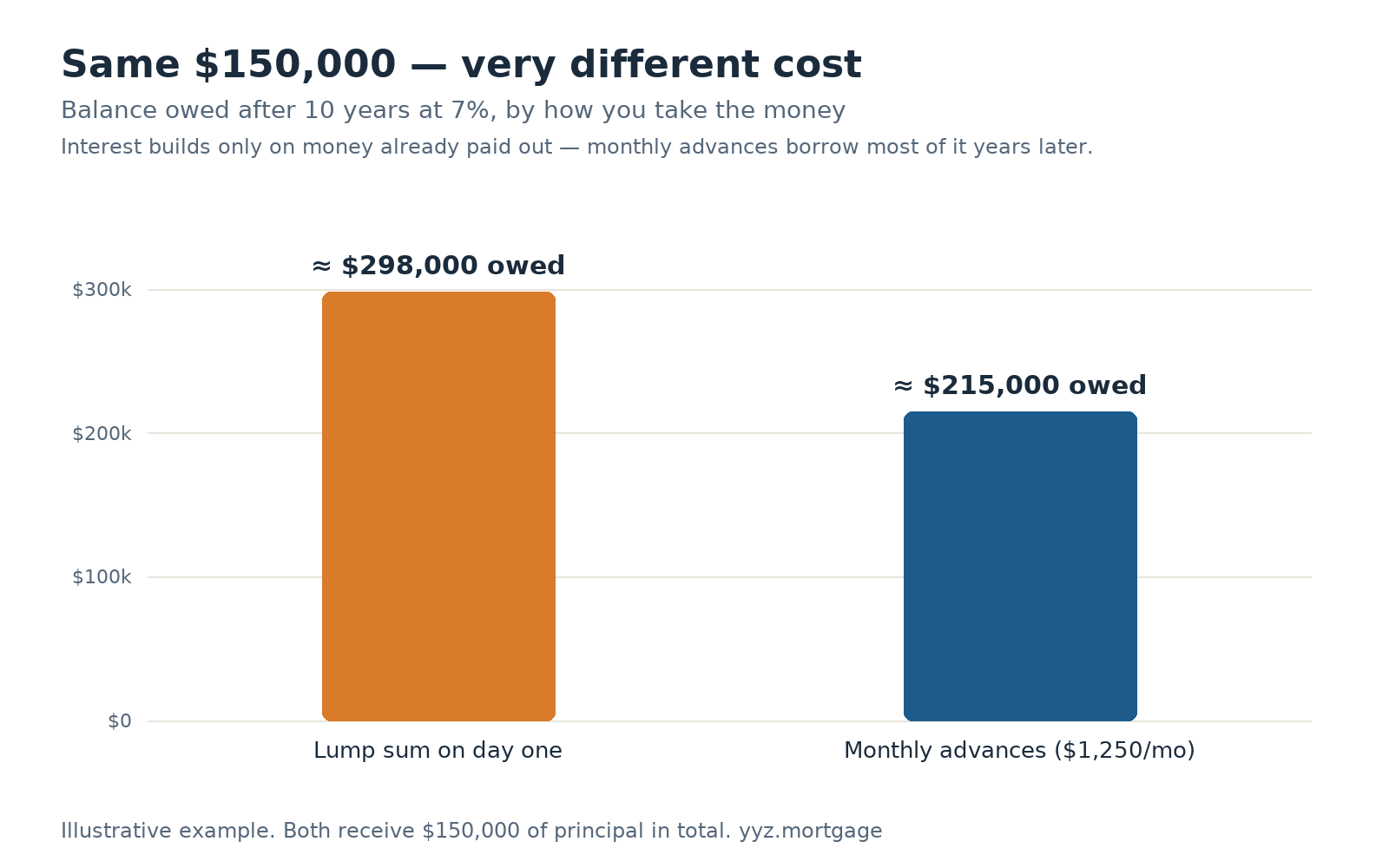
Same money in your pocket. About $83,000 less against your estate. That is no rounding error. It is the whole case for one rule: draw the money when you plan to spend it. Both figures are illustrative. Your rate resets at each term. Real products differ. The full cost guide covers the rest of the fee picture.
There is a second, quieter plus. Undrawn money does not sit in your chequing account. No one can be tempted by it. That is a real safeguard. Families who manage a parent’s money value it.
When each choice wins
A lump sum is right when the need is now, all at once:
- Paying off an existing mortgage. This is required at funding. It also ends a monthly payment.
- A big renovation, a grey-divorce buyout, or clearing 20%-interest credit cards.
- Day-one money has to be day-one borrowing. No structure gets around that.
Scheduled advances are right when the need is monthly:
- Topping up retirement income. Groceries-and-bills money — $800 or $2,000 a month.
- Paying for in-home care. That cost comes month by month, by its nature.
- Any plan where the honest answer to “when will you spend it?” is “bit by bit.”
They also play well with government benefits. Like all reverse mortgage money, scheduled advances don’t reduce OAS or GIS. They often replace RRIF withdrawals. Those withdrawals can do just that.
The blend is the most common well-built plan. A first advance covers the urgent item. Modest scheduled advances follow. One reflex we push back on, every time: taking the biggest lump sum you can, “just to have it.” That money sits parked in a 2% savings account while you pay 7% compounding. A sure loss, with no upside.
The fine print
- Fees differ by structure. Income Advantage has a $2,495 setup fee (vs $1,795 for standard CHIP). Equitable’s setup is $995 across Flex products. Extra draws may carry small processing fees and minimums.
- Rates differ slightly between products. They also reset when each term renews. We compare the current sheets, with APRs, when we build your options.
- You have room to change things — with limits. You can change your schedule and ask for extra draws. This stays within your approved limit and product rules. Confirm the details before you sign, not after.
Get it priced both ways
The right question is not “how much can I get?” It is “how much do I need, and when?” Bring the answer, even a rough one. We will price the same plan three ways: lump sum, scheduled advances, and a blend. Ten-year projections for each, free.
Start with your number. The free calculator takes a minute. No credit check. Or check if you qualify and we’ll build the comparison with you.
This article is general information, not financial, legal or tax advice. Mortgage products are subject to lender approval (OAC). Rates and product details change — confirm current terms before deciding. Speak with a licensed mortgage professional about your situation.
Frequently asked questions
Can a reverse mortgage pay me monthly like a pension?
Yes. Scheduled-advance products — like HomeEquity Bank's Income Advantage or Equitable Bank's Flex scheduled advances — deposit a set amount monthly or quarterly. Interest builds only on money actually paid out to you, so this route is far cheaper over time than taking it all up front.
Which costs less: lump sum or monthly advances?
Monthly advances cost far less when the money is for ongoing spending. Drawing $1,250 a month for ten years costs about $65,000 in interest at 7%. Taking the same $150,000 as a day-one lump sum costs about $148,000. The gap exists because most of the monthly money is borrowed years later.
When is a lump sum the right choice?
When the cost is right now and all at once. Think paying off an existing mortgage (required at setup), a big renovation, a spousal buyout, or clearing high-interest debt. Money you need on day one must be borrowed on day one — the structure question only applies to money you will spend later.
Can I combine a lump sum with monthly advances?
Yes, and many borrowers do. A first advance clears the mortgage or funds the renovation, and scheduled advances then top up monthly income. You can also leave room to ask for extra draws later, subject to lender minimums.
Can I change the structure after starting?
Generally yes, within your approved limit. You can adjust or stop scheduled advances and ask for extra draws, subject to the lender's product rules and minimum advance amounts. Stopping advances also stops new interest on money you never took.
Do monthly advances affect OAS or GIS?
No. Like all reverse mortgage proceeds (the money you get), scheduled advances are loan money, not income. So they do not reduce OAS, GIS, or CPP. That is one reason retirees compare them with RRIF withdrawals for topping up monthly cash flow.
Figures shown are estimates only — not an offer of credit or a commitment to lend. The amount you may qualify for depends on the lender's assessment of your age(s), property type, location, appraised value and any existing liens. Reverse mortgage lenders require independent legal advice before funding. A reverse mortgage is not suitable for everyone; alternatives include refinancing, a home equity line of credit, or downsizing.