reverse mortgage
Reverse Mortgages and Your Estate: What Heirs Should Know
Published July 2, 2026 · By YYZ Mortgage

Maybe you are thinking about a reverse mortgage. Or your parents are. One question tends to come first. What happens to the house, and the inheritance, when the borrower dies?
It is a fair question. The honest answer is better than most people expect. Yes, a reverse mortgage lowers the equity your estate gets in the end. But it does not stick your kids with debt. And it does not hand your home to the bank. This article walks through what heirs should know. It includes an illustrative example that shows the math over ten years.
First, the basics: who owns the home?
With a reverse mortgage, you stay the owner of your home. The lender puts a mortgage on the title. Any mortgage lender does the same thing. The title stays in your name. You can sell the home. You can fix it up. You can leave it to your heirs in your will. You just have to pay off the loan when the time comes.
In Canada, reverse mortgages come from Schedule I banks. These banks follow federal rules. The main ones are HomeEquity Bank (the CHIP Reverse Mortgage) and Equitable Bank. Want a refresher on how the product works? Start with our reverse mortgage overview or the full Ontario reverse mortgage guide.
When does the loan have to be repaid?
A reverse mortgage comes due when one of three things happens.
- The last living borrower dies.
- The home is sold.
- The borrower moves out for good (for example, into long-term care).
Until then, you make no monthly payments. Interest just builds and gets added to the balance.
The 180-day estate window
When the last borrower dies, the estate does not have to rush. With HomeEquity Bank’s CHIP product, the estate gets 180 days — about six months — to pay off the loan. That window gives the executor time to get probate. It gives time to list and sell the home in a calm way. Or the family can set up new financing if they want to keep the home.
One more thing matters just as much. No early-payment charge applies when death triggers the payoff. While the borrower is alive, paying the loan off early can bring a charge. That charge is waived on death. With CHIP, it is also cut by 50% when the borrower moves into long-term care. The estate pays back the loan plus the interest that has built up. Nothing more.
How interest compounds against your equity
Every family should understand this part well. You make no monthly payments. So interest gets added to the balance. Then new interest is charged on that bigger balance. The loan compounds — interest grows on interest. It grows faster in later years than in early ones.
Reverse mortgage rates run higher than normal mortgage rates. The gap is about 1.5 to 2.5 points. In mid-2026, top reverse mortgage rates sit in the low-to-mid 6% range at Equitable Bank. HomeEquity Bank says its rates mostly fall in the 6.5%–8.5% range. Sharp normal mortgages, by contrast, run about 3.9%–4.4%.
Here is the good news. Your home’s value is usually growing at the same time. Will your estate’s equity shrink, hold steady, or grow? That depends on a race. Your loan’s rate runs against your home’s growth. It also depends on how much you borrowed next to the home’s value.
An illustrative example: $250,000 loan on a $950,000 home
This is an illustrative example only. It is not a rate quote. It is not a forecast for any real home.
Say a homeowner takes a $250,000 reverse mortgage on a home worth $950,000. Say the home grows 3% per year. Say the loan compounds at 7% per year (compounded once a year here, to keep it simple). Here is how the numbers move.
| Year | Home value (3%/yr) | Loan balance (7%/yr) | Remaining equity |
|---|---|---|---|
| 0 | $950,000 | $250,000 | $700,000 |
| 5 | $1,101,310 | $350,638 | $750,672 |
| 10 | $1,276,721 | $491,788 | $784,933 |
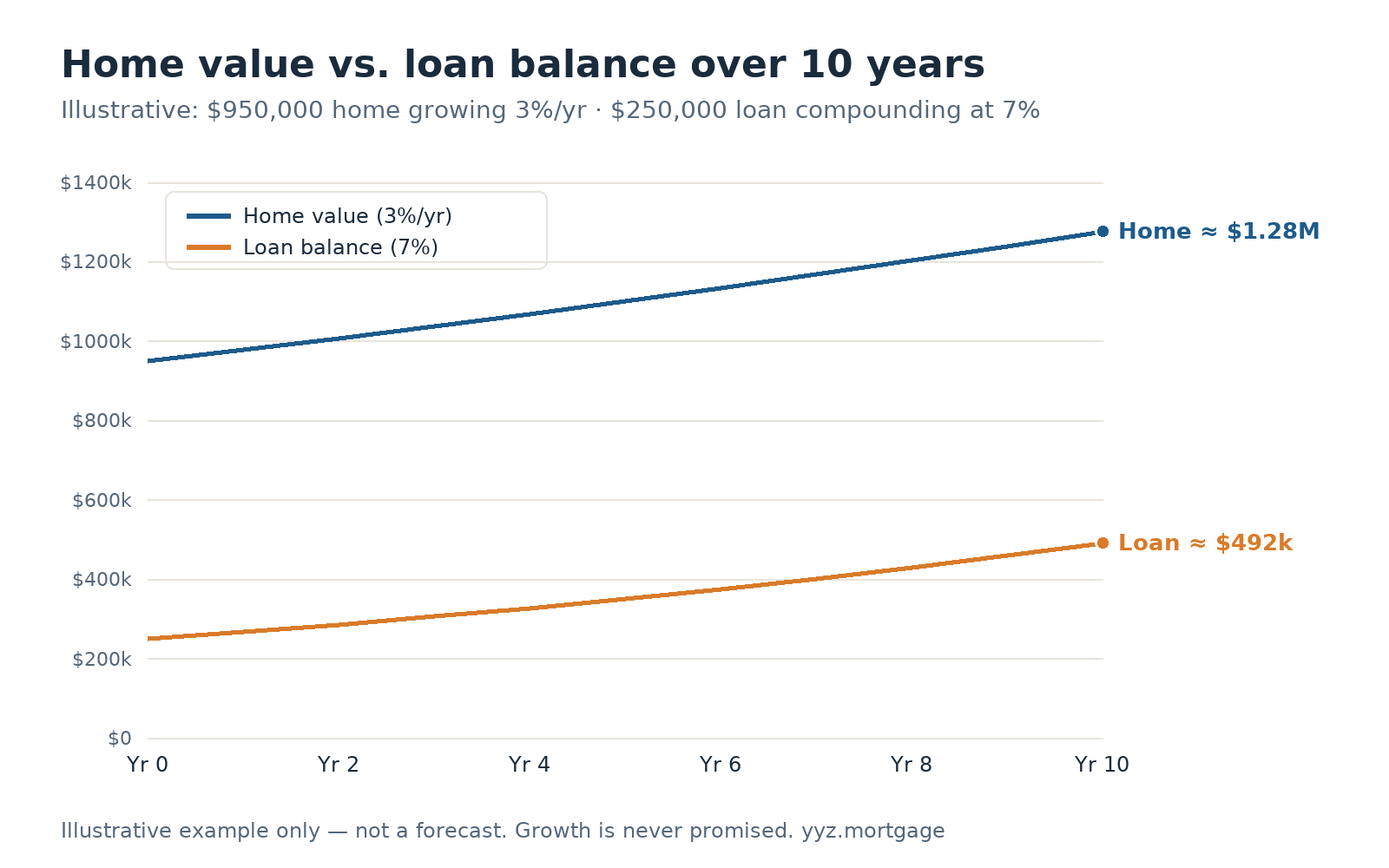
Two things stand out.
- The loan nearly doubles in ten years. $250,000 becomes about $491,800. That is what compounding at 7% does when no payments are made.
- Yet the estate’s equity grows in this case. It goes from $700,000 to about $785,000. Why? The $950,000 home gained more dollars than the interest on the much smaller loan.
Change the inputs, and the picture changes. Borrow a bigger share of the home’s value. Or assume flat or falling prices. Or run the loan 20 years instead of 10. Then equity shrinks in a real way. That is why you should model your own numbers. Our reverse mortgage calculator lets you test amounts, rates and time frames in a couple of minutes.
The no-negative-equity guarantee (and its condition)
Here is the protection heirs care about most. Canada’s major reverse mortgage lenders include a no-negative-equity guarantee. This is a promise that the debt cannot pass the home’s worth. What if the home sells for less than the loan balance when the loan comes due? The lender eats the shortfall. Your estate will not owe more than the home’s fair market value — what the home would sell for on the open market — as long as property taxes, insurance and upkeep are kept current.
That condition matters. The guarantee holds as long as the borrower kept the terms of the deal. That means paying the property taxes. It means keeping home insurance in force. It means keeping the home in fair shape. And it means living there as your principal residence — your main home. Let those slip, and the guarantee can be lost. In practice, lenders must also check up front that you can afford taxes and insurance. Federal OSFI guidance expects this, so the problem does not come up.
The other side of the guarantee matters just as much. Any money left over belongs to the estate. If the home sells for more than what is owed — and that is the common result — every extra dollar goes to your heirs, not the lender.
What heirs can actually do when the time comes
When the last borrower dies, the executor has three main paths.
- Sell the home. Pay off the balance from the sale money inside the 180-day window. The estate keeps the rest. This is the most common route.
- Keep the home. Heirs who want the home can pay off the reverse mortgage. They can use other estate money, their own funds, or a new normal mortgage or refinance in their own names. The new lender has to approve them.
- Walk away with protection. In the rare case where the debt tops the home’s value, the estate hands over the home. The no-negative-equity guarantee covers the gap — again, as long as taxes, insurance and upkeep were kept current. No other estate assets are touched.
Heirs never take on personal debt from a reverse mortgage. The loan is tied to the home, and only the home.
Independent legal advice: a built-in safeguard
Before the money flows, lenders require independent legal advice (ILA). That means you meet with your own lawyer — not the lender’s. Your lawyer goes over the contract. They explain when the loan must be repaid. They explain how the interest compounds. And they confirm you are signing freely, with a full grasp of the deal. Expect the cost to run from a few hundred dollars up to about $1,800. It depends on the lawyer and how complex things are.
For families, ILA is a real safeguard. It creates an outside record that Mom or Dad understood the deal. Adult children are often welcome at meetings with the mortgage professional too. In our experience, the smoothest files are the ones where the family was involved from the start.
Talk to your family early
You do not have to tell your children you took a reverse mortgage. But there are three strong reasons to do it anyway.
- No surprises during grief. Finding an unknown $400,000 charge on the family home while planning a funeral is a hard way to learn about it.
- Heirs can plan. A child who hopes to keep the home has six months to line up financing. But only if they see it coming.
- Better choices now. Your family may spot options you had not weighed. Or they may confirm that a reverse mortgage truly is the best fit.
A simple approach works well. Share the loan amount, the rate, and a table like the one above. Then look at it together once a year.
Is a reverse mortgage right for your estate goals?
Reverse mortgages are not for everyone. Is leaving the biggest possible inheritance your top goal? Then give the other options a hard look first.
- A home equity line of credit (HELOC) usually has a lower rate. But it needs monthly interest payments, and you must qualify on income.
- A normal refinance can also free up equity at lower rates, if your income supports the payments. See our refinance options.
- Downsizing — selling and moving to a smaller home — turns equity into cash with no interest at all. But selling and moving carry real costs of their own. We compare the two honestly in Reverse Mortgage or Downsizing?
Does much of what you have heard about reverse mortgages and estates sound scary? Some of it may just be out of date. We tackle the most common myths in 7 Reverse Mortgage Myths, Debunked.
A reverse mortgage tends to shine in a few cases. Staying in your home matters more to you than the size of the estate. Monthly payments do not work on a fixed income. And the amount you borrow is small next to the home’s value.
Next steps
Every estate result comes down to four numbers. Home value. Growth rate. Loan amount. Interest rate. You can test your own mix in minutes with our reverse mortgage calculator. You can check the basics on our qualification page. Or browse common questions in the reverse mortgage FAQ. When you are ready, a licensed mortgage professional can run lender-specific numbers for your exact case — with your family in the room, if you wish.
When one spouse passes away
The biggest estate protection in a reverse mortgage is set on day one. It is this: are both spouses borrowers?
- Both on the loan (the right way). When one spouse dies, the survivor simply carries on. The loan runs on the same terms. No payoff is triggered. No new approval is needed. The 180-day estate clock only starts after the last borrower dies or moves out for good.
- One spouse off title or off the loan. The surviving non-borrower has no right to stay. The loan comes due. The survivor must pay it off, refinance, or sell inside the lender’s window — during the worst months of their life. The United States protects some spouses who are not borrowers. Canada does not. So this cannot be fixed after the fact.
Did you remarry? Was one spouse left off title for old reasons? Raise it with the broker and both lawyers before the money flows. It is a five-minute fix at signing and a true crisis afterward. The same both-borrowers logic protects a spouse if the other moves to long-term care.
This article is general information, not financial, legal or tax advice. Mortgage products are subject to lender approval (OAC). Rates and product details change — confirm current terms before deciding. Speak with a licensed mortgage professional about your situation.
Frequently asked questions
What happens to a reverse mortgage when the homeowner dies?
The loan comes due when the last borrower dies. With HomeEquity Bank's CHIP product, the estate gets a 180-day window to pay it off, most often by selling the home or setting up a new loan. There is no early-payment charge when the loan is paid off because of a death.
Do heirs inherit reverse mortgage debt in Canada?
No. Heirs do not owe the debt themselves. The major Canadian reverse mortgage lenders include a no-negative-equity guarantee, so the estate will not owe more than the home's fair market value, as long as property taxes, insurance and upkeep were kept current.
Can my children keep the house after I pass away?
Yes, if they can pay off the reverse mortgage balance. They can use other estate money, their own savings, or a new normal mortgage or refinance in their own names. If they cannot, or do not want to, the home is usually sold and any extra money goes to the estate.
How much equity will be left for my estate?
It depends on how much you borrow, the interest rate, how long the loan runs, and how home prices move. In many cases where the home value grows a bit, real equity is left over, but that is not a sure thing. Run the numbers before you sign, and check them again over time.
Is independent legal advice required for a reverse mortgage?
Yes. The major lenders make borrowers get independent legal advice (ILA) before the money flows. Your own lawyer goes over the contract with you, makes sure you understand the terms, and checks that you are signing freely. Plan for a few hundred dollars up to about $1,800, depending on the lawyer.
Should I tell my family before taking a reverse mortgage?
We strongly suggest it, though the law does not require it. An early, open talk prevents surprises at an already hard time. It lets heirs plan how they might handle the payoff, and it gives everyone a chance to weigh other paths like a HELOC, a refinance, or downsizing.
What happens to a reverse mortgage when one spouse dies?
If both spouses are borrowers on the loan, nothing changes — the survivor stays in the home and the loan runs on the same terms. The loan only comes due after the last borrower dies or moves out for good. This is why both spouses should always be on title and on the loan.
What if the surviving spouse was never on the reverse mortgage?
A spouse who is not a borrower has no contract right to stay — the loan comes due on the borrower's death, and the survivor must pay it off, refinance, or sell. Unlike the United States, Canada has no special protected group for spouses who are not on the loan. So the protection has to be built in at signing.
Figures shown are estimates only — not an offer of credit or a commitment to lend. The amount you may qualify for depends on the lender's assessment of your age(s), property type, location, appraised value and any existing liens. Reverse mortgage lenders require independent legal advice before funding. A reverse mortgage is not suitable for everyone; alternatives include refinancing, a home equity line of credit, or downsizing.