reverse mortgage
Reverse Mortgages in Ontario: The Complete 2026 Guide
Published July 2, 2026 · By YYZ Mortgage
Do you own a home in Ontario? Are you 55 or older? Then a big share of your wealth may sit in your house. A reverse mortgage is one way to turn part of that value into tax-free cash. You do not sell. You do not move. You make no monthly mortgage payments.
Some people oversell this product. Others dismiss it unfairly. The truth sits in the middle. A reverse mortgage is a real, regulated loan. Big Canadian banks offer it under federal rules. It truly helps some retirees. It is truly wrong for others.
This guide shows how reverse mortgages work in Ontario in 2026. Who can get one. How much you can get. What the lenders offer. What it really costs. And the other options you should weigh first. No hype — just what you need to make a clear choice.
What Is a Reverse Mortgage?
A reverse mortgage is a loan secured by your home. It is for Canadian homeowners aged 55 and up. And it works “in reverse.”
- A regular mortgage: you borrow a large amount. Then you pay it down each month.
- A reverse mortgage: you borrow against your home’s value. No regular payments are needed. Interest is added to the balance over time.
You stay the owner of your home. You keep living in it. The loan is what you borrowed. Add the interest that builds up. You pay it back later. Most often that is when you sell the home. Or when you move out for good. Or after the last borrower passes away.
You can get the money as one lump sum. Or you can get set advances. Think of these as a monthly or quarterly “paycheque” from your home’s value. Some products let you mix both.
What a reverse mortgage is not
Let’s clear up a few common myths right away.
- It is not a government program. In Canada, these are private loans. The lenders are banks under federal rules. The main ones are HomeEquity Bank and Equitable Bank.
- The bank does not take your home. Title stays in your name. The lender registers a charge, as with any mortgage.
- It is not “free money.” Interest compounds on the balance. The longer the loan runs, the more of your home’s value it uses up. We show the math honestly below.
Who Can Get One in Ontario?
Qualifying is mostly about your age, your home, and your equity. Equity is the part of your home’s value you own. Income and credit matter less than with a regular mortgage. Still, lenders do a limited check of both. And every loan is subject to lender approval — OAC (on approved credit).
The core rules:
| Requirement | Details |
|---|---|
| Age | You must be at least 55. So must everyone on the home’s title, including a spouse |
| Residence | The home must be your primary residence — your main home, where you live at least part of the year |
| Home value | Usually at least $250,000 in appraised value |
| Location | Ontario city and suburb homes usually qualify. Some rural or remote homes may not |
| Existing mortgage | Allowed. But the reverse mortgage money must pay it off first, so the lender holds first position |
That last point matters more than people expect. Do you still have a mortgage on the home? Or a secured line of credit? The reverse mortgage pays that off first. What is left over comes to you.
One more rule lasts for the life of the loan. You must keep property taxes, home insurance, and basic upkeep current. These duties are a condition of the loan. They are also a condition of the no-negative-equity guarantee. That is the lender’s promise that you will not owe more than your home’s fair market value (what it would sell for) when it is sold — as long as taxes, insurance, and upkeep are kept current. More on that promise below.
Not sure if your home qualifies? Our qualification checker takes about two minutes.
How Much Can You Get?
Age is the biggest factor. Lending limits are built around how long you may live. The older you are, the more of your home’s value a lender will advance.
Canadian lenders advertise “up to 55%” of home value. Equitable Bank’s Flex PLUS goes up to 59% for borrowers 70 and older. That is the highest loan-to-value (LTV) sold in Canada today. But those are ceilings, not typical offers.
Here are typical ranges by age. These are estimates, drawn from lender materials and tools. Your real amount turns on four things. Your home’s appraised value. Its type. Its location. And the lender’s review.
| Age of youngest borrower | Typical % of home value (estimate) |
|---|---|
| 55 | 15–20% |
| 60 | 20–25% |
| 65 | 25–35% |
| 70 | 30–40% (up to 43–59% with Flex PLUS) |
| 75 | 40–50% |
| 80 | 45–52% |
| 85+ | 50–55% (up to 59%) |
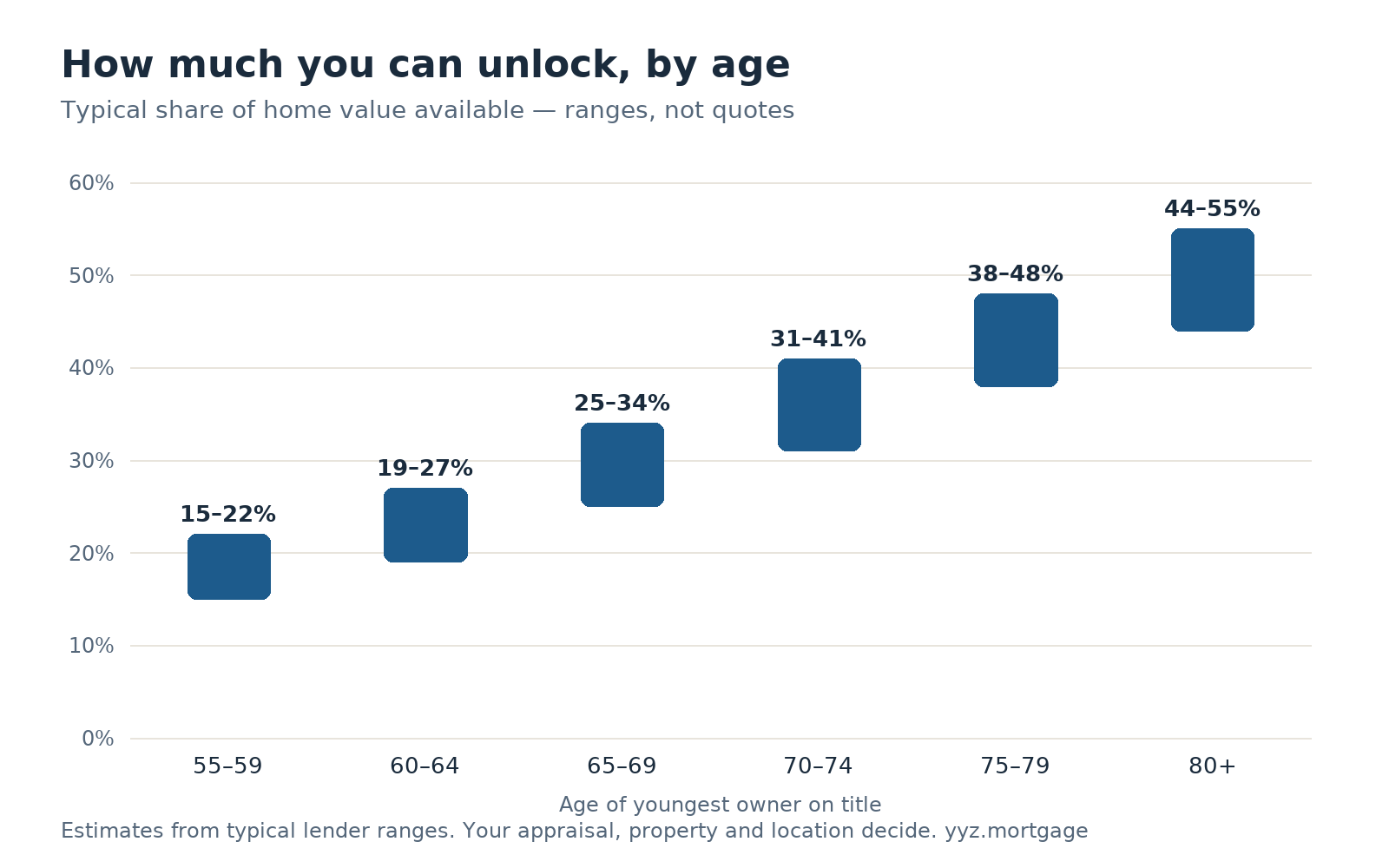
Two notes on this table.
- The youngest person on title sets the number. Say you are 75 but your spouse is 62. The lender prices for the 62-year-old.
- Location shifts the range. Homes in urban Ontario (and BC, Alberta, and Quebec) tend to land at the high end. Rural homes often qualify for less, or not at all.
Illustrative example: the average GTA home price was about $1,070,000 as of May 2026 (TRREB). Take a 70-year-old couple in that average home. At a typical 30–40% LTV, they might qualify for roughly $321,000 to $428,000. They could get even more with an age-70+ product. A 60-year-old in the same home might see $214,000 to $267,500. Same house, very different numbers. Age drives the limit.
Want a deeper dive with worked examples? See our companion article: How much can you get from a reverse mortgage?
See your numbers: get a free, no-obligation estimate with our reverse mortgage calculator. Enter your age, postal code, and rough home value. You will see a real-world range in under a minute.
The Lenders: Who Offers Reverse Mortgages in Canada?
Two big banks lead Canada’s reverse mortgage market. Both are under federal rules. A few newer lenders have joined them. We are a brokerage in the Dominion Lending Centres network. So we work with many lenders, not one brand. That matters. The products differ more than the ads suggest.
HomeEquity Bank — the CHIP family
HomeEquity Bank came first. It is still the largest reverse mortgage lender in Canada. Its CHIP brand has a few versions.
- CHIP Reverse Mortgage — the flagship. Lump sum or advances. Marketed at up to 55% of home value.
- CHIP Max — a higher-LTV version for people who need the largest amount. It is priced to match.
- CHIP Open — no prepayment charges at any time. The trade-off: a higher rate. Useful if you expect to repay soon — say, while you wait for a home to sell.
- Income Advantage — set advances (monthly or quarterly) instead of a lump sum. You draw the money bit by bit. So interest builds on less of the balance early on.
Equitable Bank — the Flex family
Equitable Bank (EQB) is the main challenger. It often has the sharper pencil on rate. Its products are sold in cities and most large towns in Ontario, Alberta, BC, and Quebec.
- Flex — the core product. Age 55+, 15–55% LTV, minimum home value $250,000.
- Flex PLUS — for borrowers 70+. LTVs of 43–59%, the highest in Canada.
- Flex Lite — a lower-LTV (15–40%) product. Lump sum only, with a loan cap of $800,000. It usually carries Equitable’s lowest rate.
Others worth knowing
- Bloom Finance — a fintech lender for homeowners 55+. It serves Ontario, BC, and Alberta. It offers up to 55% of home value. That includes a “SafeRate” lifetime fixed-rate product.
- Home Trust — offers EquityAccess (55+, up to roughly 59%). It also has a Boost product for borrowers 70+.
Which lender is right for you? It depends on your age and how much you need. It also depends on lump sum versus income stream. And on how long you plan to keep the loan. That is the exact work a broker does. We wrote a detailed head-to-head here: CHIP vs Equitable Bank Flex.
Reverse Mortgage Rates in 2026
Here is the honest part most ads skip. Reverse mortgage rates are much higher than regular mortgage rates.
As of mid-2026:
- Reverse mortgage rates run about 6.2% to 8.5%. HomeEquity Bank posts a general range of 6.5%–8.5% for CHIP products. Equitable Bank posted its 5-year fixed rates as of October 30, 2025. They ran from 6.23% (APR 6.309%) on Flex Lite to 7.43% on Flex PLUS.
- Regular mortgage rates for well-qualified borrowers are roughly 3.9% to 4.4% for 5-year fixed terms. The best 5-year fixed sits around 3.94%.
- Some context: the Bank of Canada’s policy rate is 2.25%. Bank prime is 4.45% (as of July 2026).
Rates change all the time. Always confirm current rates before you decide. Check our live rates page. Or ask us for today’s lender rate sheets with APRs.
Why is the rate higher?
You are paying for three things a regular mortgage does not give you.
- No required payments, ever. The lender may wait 10, 20, or 30 years to be repaid. Until then, it gets no cash flow.
- No-negative-equity protection. The lender takes on the risk that your balance grows past your home’s value one day. Note this promise has conditions — taxes, insurance, and upkeep must be kept current. More on that below.
- You qualify mainly on age and equity. There is only a limited income and credit check. There is no full stress-tested income check like a bank mortgage needs.
That premium is roughly 1.5 to 2.5 percentage points. It is the price of those features. Is it worth paying? That depends on your case. So always compare a reverse mortgage against a HELOC or a refinance before you commit.
Costs and Fees
On top of the rate, expect these one-time costs:
| Cost | Typical amount | Notes |
|---|---|---|
| Closing/admin fee — HomeEquity Bank | $1,795 | For CHIP and CHIP Max. CHIP Open is the greater of $2,995 or 1.25%. Income Advantage is $2,495 |
| Setup fee — Equitable Bank | $995 | Taken from your advance |
| Appraisal | $350–$600 | Paid up front to confirm home value |
| Independent legal advice (ILA) | ~$300–$1,800 | Advice from your own lawyer, separate from the lender. Lenders require it before funding. Cost varies by lawyer and case |
Most fees come out of the loan money. So before funding, you usually pay just two things yourself. The appraisal and the legal advice.
There are also prepayment charges if you repay early. Take HomeEquity Bank as an example. It usually lets you repay about 10% per year with no penalty. Full-prepayment charges are 5%, 4%, and 3% in years one through three. After that, the charge is three months’ interest. It is waived fully on death. It is cut in half on a move to long-term care. Equitable’s schedule differs. If early repayment is likely, product choice matters a lot. CHIP Open exists for exactly this reason.
We break down all of these numbers in The true cost of a reverse mortgage in Canada. That piece has a 10-year compound interest example.
The No-Negative-Equity Guarantee — Read the Fine Print
Canada’s major reverse mortgage lenders make a key promise. It is the no-negative-equity guarantee. You will never owe more than the fair market value of your home when it is sold — as long as property taxes, insurance, and upkeep are kept current.
That condition is not filler. It is the heart of the deal. What if you stop paying property taxes? Or let your home insurance lapse? Or let the home fall into bad shape? Then you are in default of your loan duties. And the guarantee can be voided.
Most borrowers keep up these normal homeowner duties. For them, the guarantee works as advertised. Say home values fall. Say the loan balance ends up above the sale price. The lender eats the shortfall. Your estate is not chased for the difference. Any money left over belongs to you or your estate.
Just never let anyone call it a no-strings promise. It is strong protection with conditions. Hear those conditions clearly before you sign.
Tax-Free Money, No Hit to OAS or GIS
Two facts draw retirees to this loan. The Financial Consumer Agency of Canada (FCAC) confirms both.
- The money is tax-free. A reverse mortgage advance is a loan, not income. It does not show up on your tax return. It does not push you into a higher bracket.
- It does not affect Old Age Security (OAS) or the Guaranteed Income Supplement (GIS). It is not income. So it does not count against income-tested benefits.
Compare that to drawing from an RRSP or RRIF. Every dollar you take out is taxable income. It can claw back GIS. It can trigger the OAS recovery tax. So for some retirees, borrowing against the house at 6–7% is cheaper after tax than draining registered savings. For others it is not. Work through this one with your tax advisor and your mortgage professional.
When Must the Loan Be Paid Back?
A reverse mortgage comes due when one of these happens.
- You sell the home. The loan is paid from the sale money. The rest of the equity is yours.
- You move out for good — say, into a retirement home or long-term care. HomeEquity Bank cuts its prepayment charge by 50% on a move to long-term care.
- The last borrower passes away. With CHIP, the estate usually has a 180-day window to repay. Most estates sell the home or refinance. And no prepayment charge applies on death.
Until one of those happens, you can stay in your home as long as you like. No payments are needed. You just have to meet your loan duties. That means taxes, insurance, and upkeep stay current. It also means the home stays your principal residence — your main home.
You can also choose to repay early, in part or in full. The prepayment terms above apply.
Pros and Cons, Honestly
The real upsides
- No monthly mortgage payments. This is the core benefit. Your cash flow in retirement improves right away.
- Tax-free money with no OAS or GIS impact.
- You stay in your home. You keep ownership. You keep any future rise in value above the loan balance.
- You qualify mainly on age and equity. The income and credit check is limited. That helps retirees whose income looks modest on paper but whose home is worth a lot.
- The no-negative-equity guarantee caps the downside for your estate. It holds as long as taxes, insurance, and upkeep are kept current.
- Flexible payout. Lump sum, set advances, or both.
The real downsides
- Higher interest rates than regular mortgages or HELOCs — roughly 1.5 to 2.5 percentage points more.
- Compound interest works against you. With no payments, the balance grows every year. At around 7%, a balance roughly doubles in about 10 years.
- Your estate shrinks. Every dollar of loan growth is a dollar less for your heirs.
- Setup costs run roughly $1,500–$3,000 all-in. That makes it poor value for short-term needs.
- Prepayment charges can sting if your plans change within the first few years. An open product avoids this.
- Your duties continue. Taxes, insurance, and upkeep must stay current. Fall behind, and you risk default and losing the guarantee.
A reverse mortgage is not for everyone. Can you qualify for a cheaper option and carry it with ease? Then that option usually wins. Which brings us to the other choices.
Other Options to Weigh First
Any good advisor will walk you through these first. FSRA (Ontario’s mortgage regulator) expects us to write down the fit and the options we weighed. That goes double for older borrowers.
Home equity line of credit (HELOC)
A HELOC usually has a lower rate than a reverse mortgage. And you borrow only what you need, when you need it. The catch? You must qualify on income and credit. You must also make monthly interest payments. For retirees with strong pension income, a HELOC is often cheaper. Can’t qualify, or can’t carry payments? Then it is a non-starter. Full head-to-head here: Reverse mortgage vs HELOC.
Refinancing or a regular mortgage
Do you have steady income? Then a standard refinance at regular rates (~3.9–4.4% in mid-2026) costs far less in interest. You will make monthly payments. You will need to pass an income test. But over 10+ years, the savings can be large.
Downsizing
Sell your home and buy something smaller. You turn equity into cash with no interest cost at all. The trade-offs are real. Moving costs. Land transfer tax. Realtor fees. Leaving a home and area you love. But for many people, downsizing is the best money answer. It deserves an honest look.
Other options
A few more paths, if they fit your case. Rent out part of your home. Draw down investments. Take a family loan. Or use a provincial property tax deferral program. None of these fits everyone either. The point is to compare.
How a Broker Helps (and What It Costs You)
Reverse mortgage lenders pay brokers a placement fee. So in most cases, our advice costs you nothing directly. You pay the same lender fees and rates you would pay going direct. Lender rates are set by the lender either way.
Here is what a licensed brokerage gets you. (We are part of the Dominion Lending Centres network.)
- A multi-lender view. We quote HomeEquity Bank and Equitable Bank. We can also check options like Bloom and Home Trust. A bank’s sales desk quotes only its own product.
- Product fit. Lump sum or set advances. Open or closed. Standard or max-LTV. The right setup can save thousands over the life of the loan.
- A written review of fit. We check whether a HELOC, a refinance, or downsizing serves you better. If a reverse mortgage is not your best path, we will say so. We arrange those other loans too.
- Help at each Ontario step. The appraisal. The independent legal advice. The closing.
The Process, Step by Step
Here is what actually happens, from first call to funding.
- First call (free). We review your age, home, current debts, and goals. We also check whether this loan even beats the other options.
- Estimate. We run your numbers with the lenders that fit. You can preview this yourself with our calculator.
- Application. You send in age and property papers. There is a limited income and credit check. Lenders must confirm you can keep paying property taxes and insurance.
- Appraisal. An outside appraiser confirms what your home is worth ($350–$600).
- Approval and offer. The lender issues a commitment in writing. It shows your amount, rate, APR, and all fees.
- Independent legal advice. You meet your own lawyer, separate from the lender. Lenders need this before funding. The lawyer confirms you understand the contract and are signing freely. This step protects you.
- Funding. Any existing mortgage is paid off first. The rest of the money comes to you — as a lump sum, set advances, or both.
Most files take a few weeks from start to funding. The appraisal and legal bookings set the pace.
Is a Reverse Mortgage Right for You?
It tends to make sense when most of these are true.
- You are 55+ (ideally 65+, when lending limits jump).
- You plan to stay in your home for the long term — at least 5+ years.
- You need cash flow or a lump sum. Monthly payments would strain your budget.
- You can’t qualify for — or don’t want — a HELOC or refinance.
- You have weighed the hit to your estate. Ideally, you have talked to your family too.
It tends not to make sense in a few cases. You might move within a few years. You qualify with ease for cheaper borrowing. Or your top goal is leaving the largest estate you can.
Ready to see real numbers? Start with a free, no-obligation estimate from our reverse mortgage calculator. Or see if you qualify in two minutes at our qualification page. Prefer to talk it through? That is what we are here for. Honest answers, many lenders, no pressure.
Still have questions? Our reverse mortgage FAQ covers the details. Or visit our main reverse mortgage page for the big picture.
This article is general information, not financial, legal or tax advice. Mortgage products are subject to lender approval (OAC). Rates and product details change — confirm current terms before deciding. Speak with a licensed mortgage professional about your situation.
Frequently asked questions
Who qualifies for a reverse mortgage in Ontario?
You must be at least 55, and so must everyone on the home's title. The home must be your main home, and most lenders want a home value of about $250,000 or more. Location matters too: homes in Ontario cities and suburbs usually qualify, but some rural homes may not.
How much money can I get from a reverse mortgage?
Most Canadian reverse mortgages pay out about 15% to 55% of your home's appraised value. Some products for people 70 and older go up to 59%. The older you are, the more you can borrow. Your exact amount depends on your age, home value, home type, and location, so treat any table as a rough guide.
Is reverse mortgage money taxable in Canada?
No. The money is a loan, not income, so it is tax-free. The Financial Consumer Agency of Canada says it also does not affect Old Age Security (OAS) or the Guaranteed Income Supplement (GIS).
Do I have to make monthly payments on a reverse mortgage?
No regular payments are required. Interest is added to the balance over time. The loan is paid back when you sell the home, move out for good, or after the last borrower passes away. Most lenders let you pay back part of the balance each year if you choose, but limits and charges can apply.
Can I owe more than my home is worth?
The big Canadian reverse mortgage lenders offer a no-negative-equity guarantee. You will not owe more than the fair market value of your home when it is sold — as long as property taxes, insurance, and upkeep are kept current. If you fall behind on those duties, the guarantee can be voided. It is a lender promise with conditions, not a government program.
What happens to my reverse mortgage when I die?
The loan comes due after the last borrower passes away. With HomeEquity Bank's CHIP, the estate usually has 180 days to pay it back, most often by selling the home or refinancing. No prepayment charge applies on death. Any equity left after the loan is paid belongs to your estate.
What does a reverse mortgage cost compared to a regular mortgage?
Reverse mortgage rates in mid-2026 run about 6.2% to 8.5%. The best regular mortgage rates are about 3.9% to 4.4%. You pay that extra for the right to skip monthly payments for life. Setup costs include a closing or admin fee ($995 to $1,795 at the big lenders), an appraisal, and independent legal advice.
Is a reverse mortgage a good idea for everyone?
No. It fits homeowners 55+ who want to stay in their home and need cash without monthly payments. But the higher rate compounds over time and shrinks your estate. Options like a HELOC, a refinance, or downsizing can cost less if you qualify, so always compare them first.
Figures shown are estimates only — not an offer of credit or a commitment to lend. The amount you may qualify for depends on the lender's assessment of your age(s), property type, location, appraised value and any existing liens. Reverse mortgage lenders require independent legal advice before funding. A reverse mortgage is not suitable for everyone; alternatives include refinancing, a home equity line of credit, or downsizing.