reverse mortgage
How Much Can You Get From a Reverse Mortgage?
Published July 2, 2026 · By YYZ Mortgage
People ask one thing first about a reverse mortgage. How much money can I get?
Here is the honest answer. It depends mostly on your age. Then it depends on your home. Lenders in Canada offer roughly 15% to 55% of a home’s appraised value. That value is what a pro appraiser says it is worth. One product goes up to 59%. Your spot in that range depends on one thing. The age of the youngest person on title.
This article walks through the usual ranges by age. It shows worked examples with real Greater Toronto Area prices. It also explains what moves your number up or down. Want your own figure right away? Our reverse mortgage calculator gives a free estimate. It takes under a minute.
Why Age Is the Biggest Factor
A reverse mortgage has no monthly payments. Interest is simply added to the balance over time. The loan is repaid when you sell or move out for good. It is also repaid after the last borrower passes away.
So the lender’s math is all about time. A loan to a 58-year-old might run 30 years. A loan to an 82-year-old likely will not. A longer loan leaves more time for interest to build. The lender must leave room for that before the balance nears the home’s value. So younger borrowers get a smaller share. Older borrowers get a larger one.
One rule trips people up all the time. The youngest borrower sets the limit. Everyone on title must be at least 55. The lender prices off the youngest of them. Say a 78-year-old owns the home with a 61-year-old spouse. To the lender, that is a 61-year-old’s file.
Typical Loan-to-Value by Age
These are typical ranges, and they are estimates — not quotes. They come from lender guides and calculators. Your real offer depends on your home’s appraised value, type, and location. Every file also needs lender approval — OAC (on approved credit).
| Age of youngest borrower | Typical % of home value (estimate) |
|---|---|
| 55 | 15–20% |
| 60 | 20–25% |
| 65 | 25–35% |
| 70 | 30–40% (up to 43–59% with age-70+ products) |
| 75 | 40–50% |
| 80 | 45–52% |
| 85+ | 50–55% (up to 59%) |
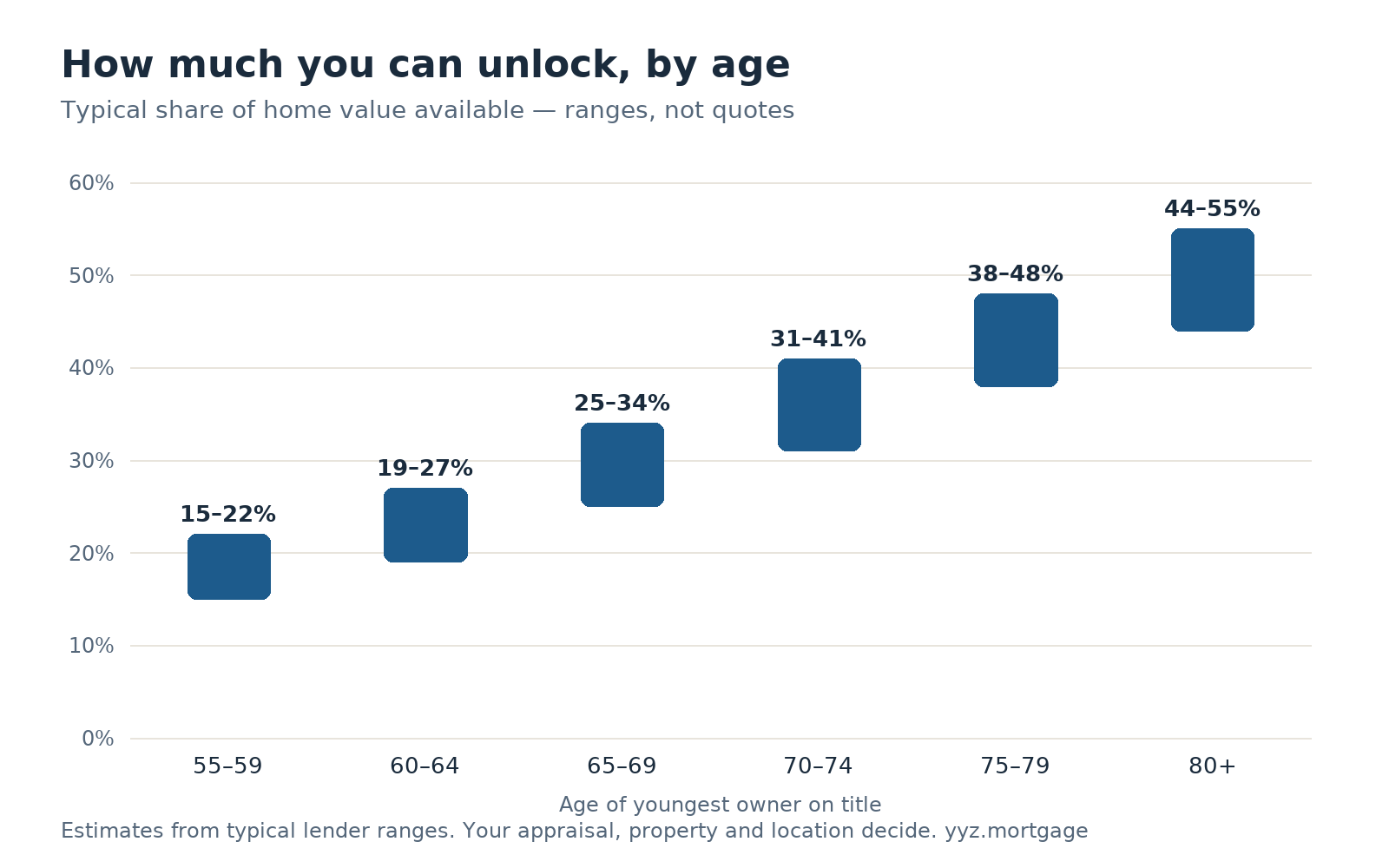
Ads say “up to 55%”, and that is real. But it applies to older borrowers in strong city markets. It does not fit most 60-year-olds. Lenders call this share the loan-to-value, or LTV. That is the percent of your home’s value you can borrow. Equitable Bank’s Flex PLUS is only for borrowers 70 and older. It has the highest LTV range in Canada right now: 43–59%.
Worked Examples: GTA Home Prices
Let’s turn those percents into dollars. We will use two price points. Both come from the Toronto Regional Real Estate Board’s May 2026 data:
- Average GTA home price: about $1,070,000.
- HPI benchmark (a “typical” GTA home): about $946,500.
All figures below are illustrative examples (sample numbers only). They are rounded. They use the estimate ranges above. An appraisal and a lender review set your real numbers.
Illustrative example 1: the average GTA home (~$1,070,000)
| Age of youngest borrower | Estimated range on a $1,070,000 home |
|---|---|
| 55 | $160,000 – $214,000 |
| 60 | $214,000 – $267,000 |
| 65 | $267,000 – $374,000 |
| 70 | $321,000 – $428,000 |
| 75 | $428,000 – $535,000 |
| 80 | $481,000 – $556,000 |
| 85+ | $535,000 – $588,000 (up to ~$631,000 at 59%) |
Illustrative example 2: the benchmark GTA home (~$946,500)
| Age of youngest borrower | Estimated range on a $946,500 home |
|---|---|
| 55 | $142,000 – $189,000 |
| 60 | $189,000 – $237,000 |
| 65 | $237,000 – $331,000 |
| 70 | $284,000 – $379,000 |
| 75 | $379,000 – $473,000 |
| 80 | $426,000 – $492,000 |
| 85+ | $473,000 – $521,000 (up to ~$558,000 at 59%) |
See the pattern? Waiting matters. The same couple in the same home could get more at 70. About $100,000 more than at 65. That does not mean wait. Not if you need the money now. But maybe your need is a few years away. Then time works for you. Your age goes up. Your home’s price may go up too.
See your own numbers: get a free estimate with our reverse mortgage calculator. There is no cost and no pressure. It uses your age, postal code, and home value.
What Else Moves Your Number
Age is the big one. But four other things shape your actual offer:
1. Appraised value — not your guess, not your tax assessment
Lenders lend against a pro appraisal. That is a formal report on what your home is worth. It costs $350–$600, and you usually pay it up front. GTA average prices were down about 4.6% year over year. (As of May 2026.) So an appraisal can come in below what an owner expects. Build a cushion into your plan.
2. Property type and location
Detached homes in cities and suburbs qualify at the strongest ranges. Condos and some other home types may qualify for a bit less. Rural and remote homes often qualify for less — or not at all. Equitable Bank, for one, lends only in cities and most large towns. That covers Ontario, Alberta, BC, and Quebec. Most lenders also want a home value of at least $250,000.
3. Existing debts on the home
A reverse mortgage must be the first loan on title. Owe $200,000 on a mortgage or HELOC (a home equity line of credit)? That gets paid off first, and you get what is left. Illustrative example: you qualify for $400,000 and owe $200,000. You net $200,000 in cash. You also drop your monthly mortgage payment for good.
4. Product choice
Products carry different limits. Equitable’s Flex Lite caps at 40% LTV and an $800,000 top loan. But it often has the lowest rate. CHIP Max pushes the LTV higher, at a higher rate. “Most money” or “cheapest money” is one of the key choices. A broker who quotes many lenders can price both paths for you. See how they compare: CHIP vs Equitable Bank Flex.
Qualifying vs. Taking the Maximum
Here is advice you will not hear in a lender’s ad. You can qualify for a number and still not take it.
Reverse mortgage rates in mid-2026 run about 6.2%–8.5%. Regular mortgage rates run about 3.9%–4.4%. (Rates change — check current rates on our rates page.) No payments are due, so interest compounds — it grows on itself. At around 7%, a balance roughly doubles in about 10 years. Every extra dollar you draw grows against your equity. That is your share of the home’s value.
Ways borrowers keep the cost down:
- Take less than the maximum. Draw what you need. Keep the rest of your equity working for you.
- Use scheduled advances instead of one lump sum. HomeEquity Bank’s Income Advantage is one example. Then interest builds on less money in the early years.
- Compare other options first. If your income qualifies, a HELOC or a refinance has a lower rate. See reverse mortgage vs HELOC. Downsizing means you pay no interest at all. A reverse mortgage is not for everyone. Sometimes one of these fits better.
Want the full cost picture? That means fees, compound interest, and what is usually left for your estate. Read The true cost of a reverse mortgage in Canada.
Getting a Real Number
Estimates are useful. Real numbers are better. Here is how to get one:
- Run the calculator. Our reverse mortgage calculator gives you a real range right away. It is free, with no strings attached.
- Check the basics. Two minutes on our qualification page covers them. You must be 55 or older. The home must be your principal residence. That is the home you live in most of the time. It must meet the minimum value. And it must be in the right spot.
- Talk to us. We are a Dominion Lending Centres brokerage. We quote more than one lender. That includes HomeEquity Bank and Equitable Bank. You see the amounts and rates side by side. Does a reverse mortgage beat your other options at all? We will tell you that too.
The right amount is not the biggest number a lender will approve. It is the number that solves your problem. At the lowest long-term cost. That takes a real talk, not an ad.
Do income and credit matter?
Far less than with any other mortgage. That is exactly why this product exists. There is no stress test and no GDS/TDS ratio. There is no minimum credit score in the usual sense. Lenders do review your credit file. They confirm you can keep paying property taxes and home insurance. But approval runs on age, appraised value, home type, and location. Some people get turned down for a HELOC on income grounds. They get approved for reverse mortgages every day. Call it a “limited income and credit review,” not “no checks.”
Two floors to know. The home usually needs an appraised value of about $250,000. And it must be your principal residence. Full property rules are in which properties qualify.
This article is general information, not financial, legal or tax advice. Mortgage products are subject to lender approval (OAC). Rates and product details change — confirm current terms before deciding. Speak with a licensed mortgage professional about your situation.
Frequently asked questions
What percentage of my home's value can I borrow with a reverse mortgage?
Most reverse mortgages in Canada let you borrow about 15% to 55% of your home's appraised value. Borrowers aged 70 and older may get up to 59% through Equitable Bank's Flex PLUS, the highest limit in Canada right now. Your exact percent depends mainly on your age, plus your home's value, type, and location.
Does my age really change how much I can borrow?
Yes, more than anything else. A 55-year-old might qualify for about 15% to 20% of their home's value, while an 80-year-old might qualify for 45% to 52%. Lenders set limits based on life expectancy, because interest grows for as long as you keep the loan. The youngest person on the property title sets the number.
How much could I get on an average GTA home?
Here is an illustrative example. On the average GTA home price of about $1,070,000 (TRREB, May 2026), a 70-year-old might qualify for about $321,000 to $428,000 at typical ranges, while a 60-year-old might see about $214,000 to $267,500. These are estimates only; an appraisal and a lender review set your actual amount.
Do I get the full amount if I still have a mortgage on my home?
No. Any mortgage or secured line of credit on the home must be paid off first from the reverse mortgage proceeds (the money you get), because the new lender must be first on title. Whatever is left after that payout is yours to use.
Should I take the maximum amount available?
Usually not, unless you need it. Interest grows on everything you draw, so borrowing more than you need eats your equity faster. Many borrowers take a smaller lump sum or scheduled advances, so interest builds on less money in the early years.
What credit score do you need for a reverse mortgage in Canada?
There is no minimum credit score the way a regular mortgage has one. Approval rests on age, home value, home type, and location. Lenders do check your credit file and confirm you can keep paying property taxes and insurance. But bruised credit or low income rarely stops an otherwise eligible homeowner.
What is the minimum home value for a reverse mortgage?
About $250,000 of appraised value with Canada's major reverse mortgage lenders. Below that, setup costs eat too much of the small amount you could get, and a HELOC or refinance usually works better.
Figures shown are estimates only — not an offer of credit or a commitment to lend. The amount you may qualify for depends on the lender's assessment of your age(s), property type, location, appraised value and any existing liens. Reverse mortgage lenders require independent legal advice before funding. A reverse mortgage is not suitable for everyone; alternatives include refinancing, a home equity line of credit, or downsizing.