reverse mortgage
How to Talk to Your Parents About Money
Published July 4, 2026 · By YYZ Mortgage

No one teaches you this part. One day you are the kid. The next day you are helping your mom read a mortgage letter.
Most families put the money talk off for years. Then a crisis forces it — in a hospital hallway, under stress, with no notes. There is a better way. Here it is, step by step.
Why this talk is so hard
Name the problem first. It is not math. It is pride.
Your parents ran a household for forty years. They raised you. Money questions can sound like “you can’t handle this anymore.” That is why direct attacks fail. “Dad, we need to talk about your finances” makes a proud man defensive by word four.
The fix is simple. Change the direction of the question.
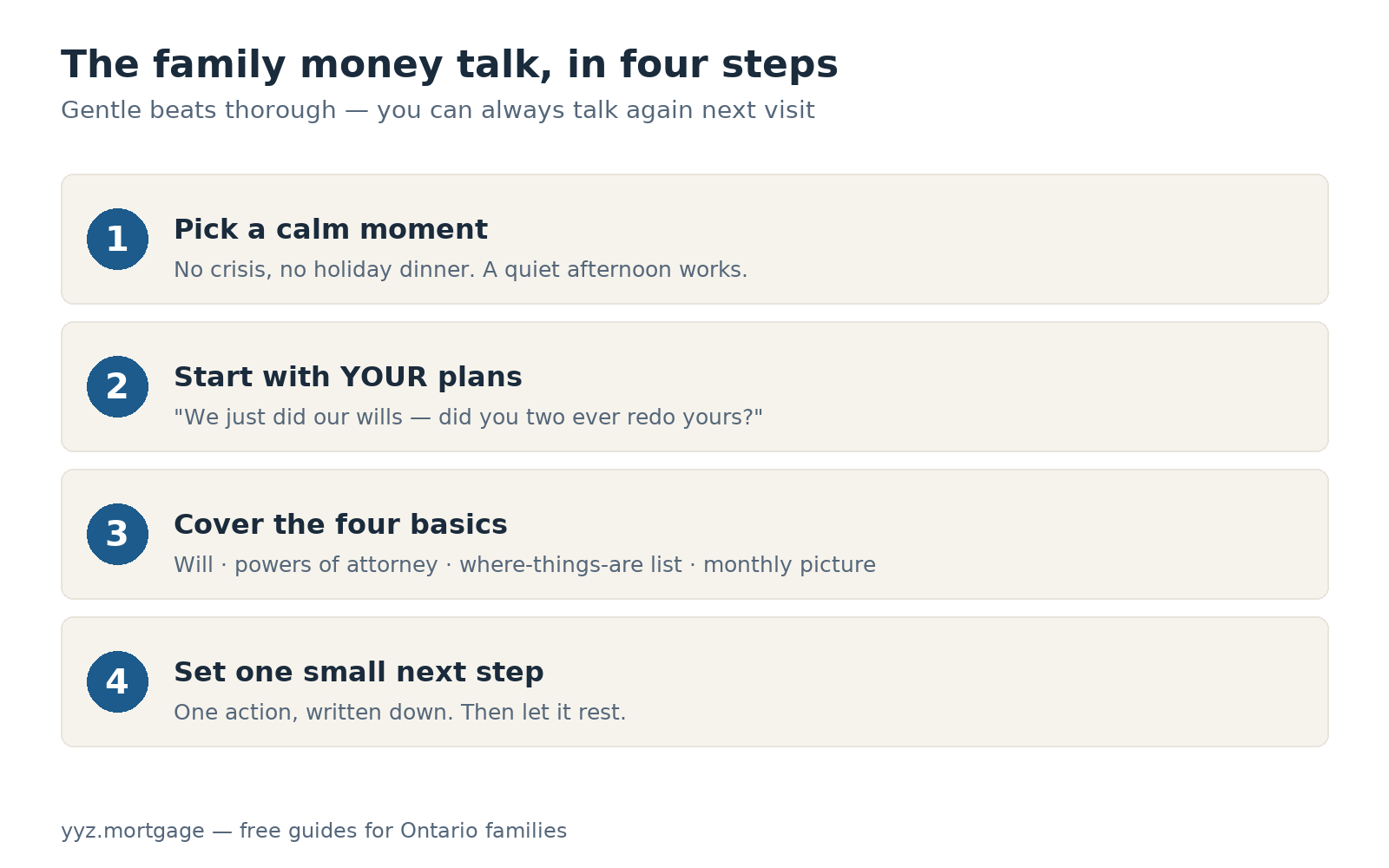
Step 1: Start with your own plans
The gentlest door-opener there is: talk about you.
- “We just did our wills. Did you and Mom ever redo yours?”
- “Work made me pick a power of attorney. Who did you two pick?”
- “We’re checking our house insurance. Who do you use?”
Now you are not inspecting them. You are asking their advice. Parents love giving advice. The talk starts itself.
Step 2: Cover the four basics
You do not need account numbers. You need to know four things exist:
- A will. Current, and someone knows where it is.
- Powers of attorney. One for property (money and the home) and one for personal care. These matter before death — a will only works after. If these are missing, this is job one. Read why the property one matters so much.
- A “where things are” list. Banks, insurance, the lawyer’s name, the accountant’s name. One page. A shoebox works.
- The monthly picture. What comes in. What goes out. Whether the gap is growing.
That last one is where many adult children get a surprise.
Step 3: If the answer is “we’re a bit tight”
Stay calm. This is the most common money story for Ontario seniors: the home is worth a lot, the monthly budget is thin. It even has a name — house rich, cash poor.
Do not jump to a fix in the same conversation. Say this instead: “Okay. There are lots of options. Let’s look at them together next week.” Then learn the menu:
- Free things first: unclaimed benefits like GIS, and property tax deferral. Many cities offer it.
- Borrowing tools: a HELOC or refinance if income allows, or a reverse mortgage at 55+ with no monthly payment.
- Bigger moves: downsizing, or renting out part of the home.
The full list, with honest pros and cons, is here: house rich, cash poor: 7 options. If a reverse mortgage comes up, our family guide and question checklist were written for exactly this moment.
Step 4: Bring in the siblings
One shared talk beats five private ones. When every sibling hears the same numbers at the same time, no one imagines the worst later. Money secrets are where family fights are born — we wrote a whole guide on sibling disagreements because we see it so often.
Live far away? Put a phone on speaker in the kitchen. Presence matters more than geography.
What to skip
- Skip the lecture. One question beats ten statements.
- Skip the takeover. Your job is to help them decide, not to decide.
- Skip the deadline. Nothing here needs to finish today. Seeds grow.
- Skip the guilt. If the first try fails, smile and try again next visit.
When an outside voice helps
Sometimes parents will tell a professional what they will not tell a child. A lawyer for the will and powers of attorney. An accountant for taxes and benefits. A licensed mortgage professional for the home-equity questions — we sit with families every week, kids on the call welcome, no pressure, no cost.
And if the talk turns to the house: the free calculator takes one minute and shows what the home could unlock. Numbers on the table make every family talk easier.
This article is general information, not financial, legal or tax advice. Mortgage products are subject to lender approval (OAC). Rates and product details change — confirm current terms before deciding. Speak with a licensed mortgage professional about your situation.
Frequently asked questions
When should I talk to my parents about their finances?
Before there is a crisis. The best time is when everyone is healthy and calm. A health scare, a fall, or a death in the family forces the talk under pressure. Early talks are shorter, kinder, and better.
How do I bring up money without offending my parents?
Start with your own planning, not theirs. Say you are doing your own will or checking your own insurance, and ask what they did. Asking for their advice opens doors. Telling them what to do closes doors.
What financial things should my parents have in place?
Four basics. A will. Powers of attorney for property and for care. A list of accounts and where things are. And a clear monthly picture — what comes in, what goes out. Everything else builds on those four.
My parents are short on cash but own their home. What should I know?
This is common. It is called house rich, cash poor. There are seven real options, from free benefit checks to a reverse mortgage to downsizing. Learn the menu before the talk, so you can explore choices together instead of pushing one.
Should all the siblings be part of the money talk?
Ideally yes, and early. Surprises breed suspicion. When every sibling hears the same numbers at the same time, the family fights less later. One shared conversation beats five private ones.
What if my parents refuse to talk about money?
Do not force it. Plant a seed and come back. Try a smaller piece — just the will, or just one bill. Sometimes an outside voice helps: a lawyer, an accountant, or a licensed mortgage professional can say things a child cannot.
Figures shown are estimates only — not an offer of credit or a commitment to lend. The amount you may qualify for depends on the lender's assessment of your age(s), property type, location, appraised value and any existing liens. Reverse mortgage lenders require independent legal advice before funding. A reverse mortgage is not suitable for everyone; alternatives include refinancing, a home equity line of credit, or downsizing.