reverse mortgage
What Senior Care Really Costs in Ontario (2026)
Published July 5, 2026 · By YYZ Mortgage
Every family hits this question at some point. What does care really cost? The answers are hard to find. One system is government-capped. One is private and shy about prices. One is billed by the hour.
Here are the real Ontario numbers for 2026, in one place. Plus how families pay in real life.
Option 1: care at home
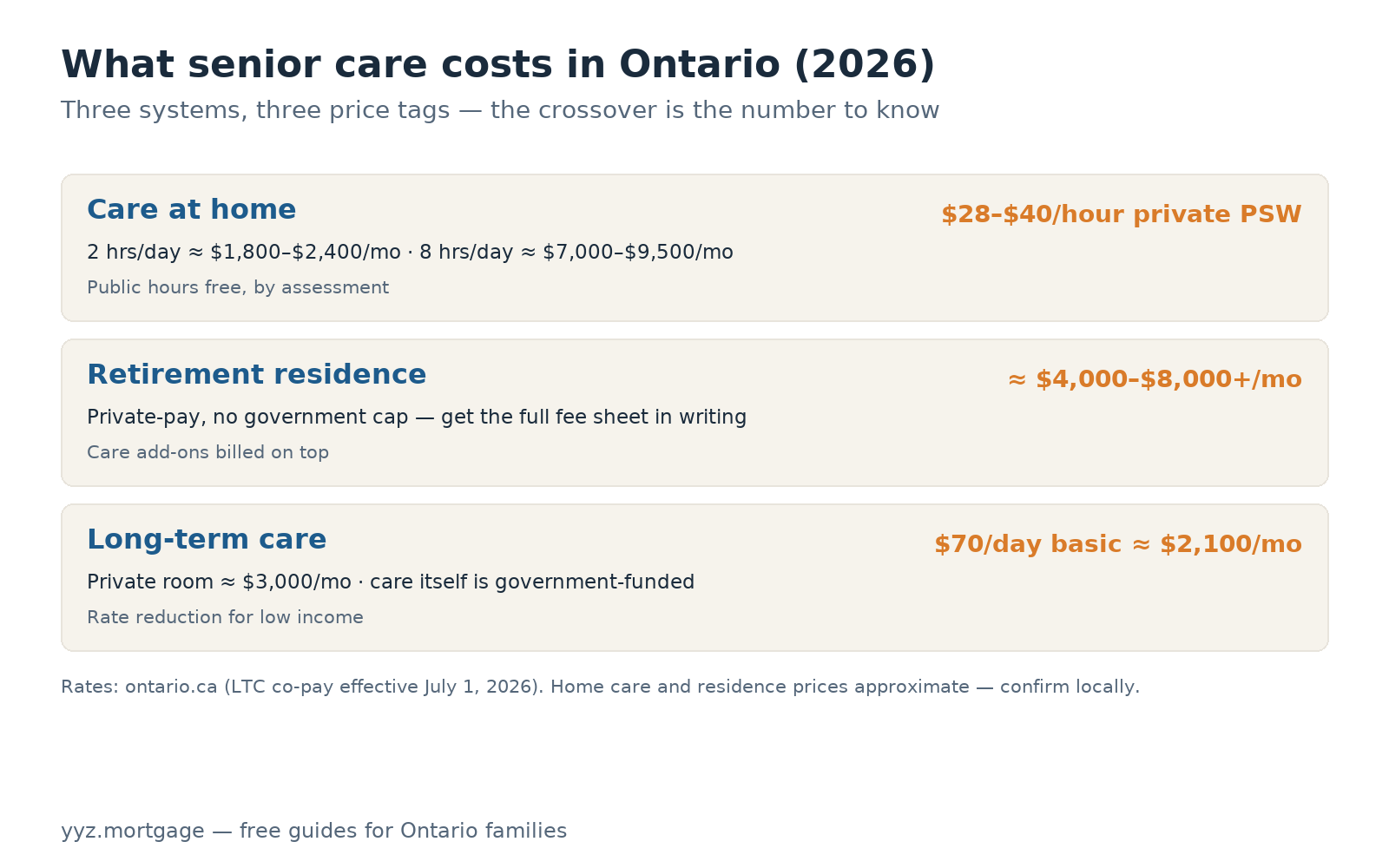
What it costs: Ontario funds some home-care hours through the public system. A needs check sets how many. Those hours are free. Past them, families hire on their own. A personal support worker (PSW) runs about $28–$40 an hour (rough range; agencies vary).
The math families should do:
| Private hours | Rough monthly cost |
|---|---|
| 2 hours a day | ~$1,800–$2,400 |
| 4 hours a day | ~$3,500–$5,000 |
| 8 hours a day | ~$7,000–$9,500 |
Illustrative example. Four hours a day of private help, plus the public hours, runs about $4,000 a month. That keeps many people home for years. In the house they love, near their people.
The advantage nobody prices: most seniors want to stay home. Home care spends money on that wish directly.
Option 2: retirement residence
What it costs: these are private businesses. No government cap. No set menu. In the GTA, expect roughly $4,000–$8,000+ a month (approximate). The range moves with the building, the suite, and care add-ons. Those add-ons are often billed on top.
What to know: tour more than one. Get the full fee sheet in writing. Ask what “care levels” cost as needs grow. The base rent is rarely the real monthly number two years in.
Some families use a short reverse-mortgage bridge here. One spouse moves to a residence. The other stays home. The equity funds the overlap. The long-term-care guide covers the loan side. It walks through every version of that story.
Option 3: long-term care (LTC)
What it costs: the care itself is government-funded. Residents pay room and board only, at capped rates. As of July 1, 2026:
| Room | Daily cap | Rough monthly |
|---|---|---|
| Basic | $70.00 | ~$2,100 |
| Semi-private | ~$84.40 | ~$2,530 |
| Private | ~$100.01 | ~$3,000 |
Two big facts. Low-income residents can apply for a rate reduction on basic rooms. Nobody is turned away for money. And waitlists are real, often long. Popular homes have the longest ones. Plan early.
The crossover point
Here is the comparison families miss. Heavy home care costs more than LTC. Eight hours a day at home runs ~$8,000/mo. A private LTC room runs ~$3,000/mo. Light home care costs less than anything. The honest sequence for many families:
- Light home care while needs are small. Cheapest, and home.
- More hours as needs grow. Still home, costs rising.
- The crossover decision. Home hours can pass roughly $5,000–$6,000 a month. At that point, compare honestly against residences and LTC.
Run your own crossover number. It turns a scary, vague choice into simple math.
How families pay
The usual ladder:
- Income and benefits first. Pensions, and check for unclaimed GIS. For LTC basic rooms, the rate-reduction subsidy.
- Then savings. But watch out: RRIF withdrawals are taxed. They can cut GIS too.
- Then the house. For most Ontario families, the home is the biggest asset. It can fund the care that keeps you in it:
- A HELOC or refinance, if income qualifies. Cheaper rates, but monthly payments are required.
- A reverse mortgage at 55+. No income test. No monthly payment. Care bills come monthly, so monthly advances fit them well. Interest builds only on money already drawn. The money is tax-free. It does not touch OAS or GIS.
- All seven options, compared honestly: house rich, cash poor.
One caution from the red flags guide: fund care month by month, as it happens. The need might be five years off. Nobody should borrow a giant lump sum for it today. Interest would build the whole time for nothing.
Want the funding side priced for your family’s plan? The free calculator shows what the home could provide. Then talk it through with us, free. Bring the kids and the care quotes. We will build the crossover math together.
This article is general information, not financial, legal or tax advice. Care prices are approximate and change; confirm current rates with providers and ontario.ca. Mortgage products are subject to lender approval (OAC). Rates and product details change — confirm current terms before deciding. Speak with a licensed mortgage professional about your situation.
Frequently asked questions
How much does long-term care cost in Ontario in 2026?
The care itself is government-funded. Residents pay only for room and board. As of July 1, 2026, basic accommodation is capped at $70.00 a day — about $2,100 a month. A private room adds about $30 a day, so roughly $3,000 a month. Low-income residents can apply to pay less for a basic room.
How much do retirement homes cost in Ontario?
Retirement residences are private businesses with no government cap. In the GTA, expect roughly $4,000 to $8,000 a month or more, depending on the building, suite and care add-ons. Prices are approximate — always tour and get the fee sheet in writing.
What does home care cost in Ontario?
Ontario provides some free home-care hours based on assessed need. Beyond that, private personal support workers commonly run about $28 to $40 an hour. Four hours a day adds up to roughly $3,500 to $5,000 a month.
Does OHIP pay for long-term care or retirement homes?
Long-term care: the care portion, yes — you pay room and board only. Retirement homes: no — they are fully private-pay. Home care: partly, through assessed public hours; you pay for anything beyond them.
How do families pay for senior care?
Usually a mix: pensions and savings first, then home equity. Options include a HELOC or refinance if income qualifies, and for homeowners 55+ a reverse mortgage — often with monthly advances that match the monthly shape of care bills. Compare all of them before choosing.
Is it cheaper to stay home with care or move to a residence?
It depends on hours needed. Light care at home is far cheaper than a residence. Heavy care at home — say eight hours a day — can cost more than long-term care. The crossover point is the number families should actually calculate.
Figures shown are estimates only — not an offer of credit or a commitment to lend. The amount you may qualify for depends on the lender's assessment of your age(s), property type, location, appraised value and any existing liens. Reverse mortgage lenders require independent legal advice before funding. A reverse mortgage is not suitable for everyone; alternatives include refinancing, a home equity line of credit, or downsizing.